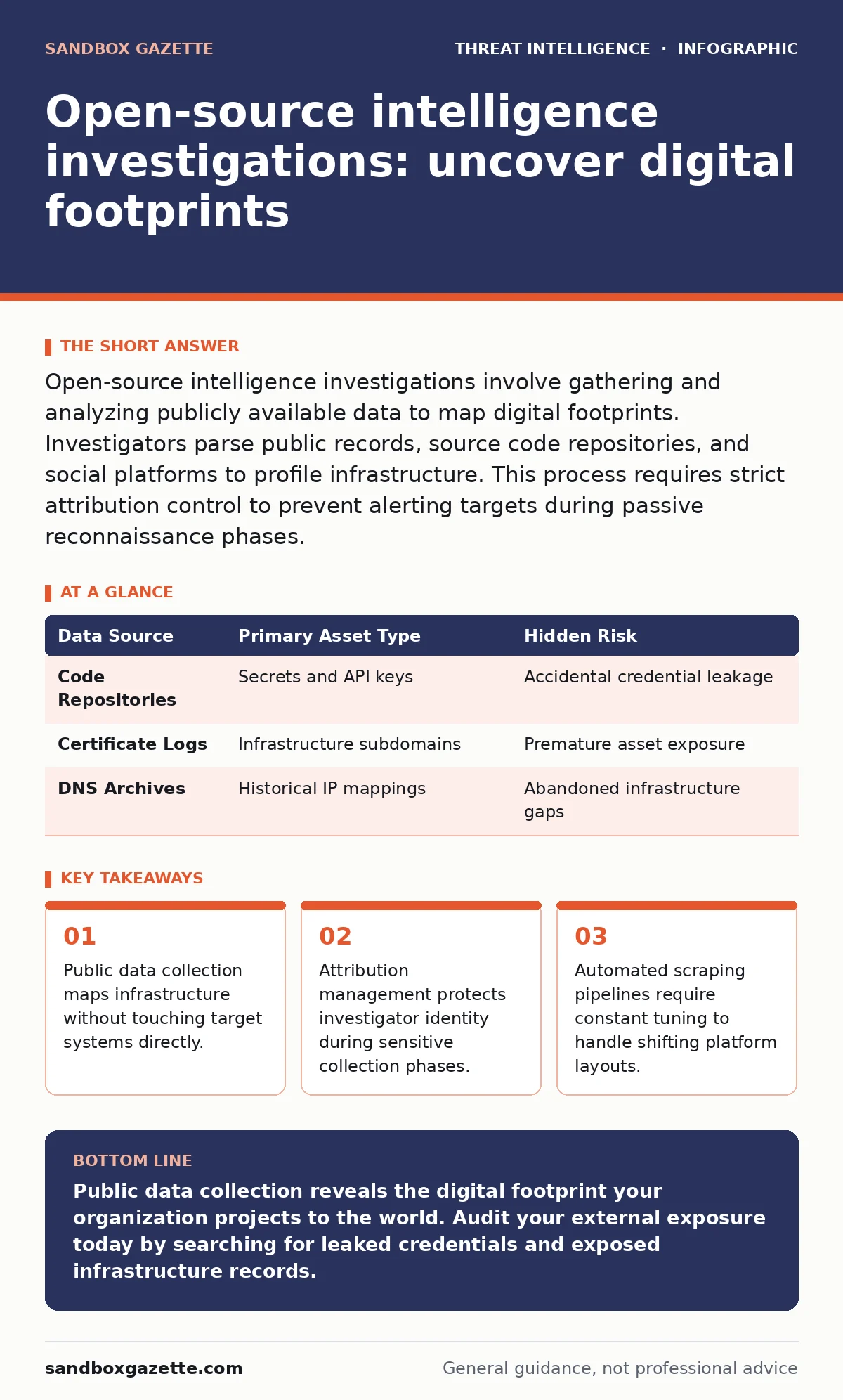
Open-source intelligence investigations involve gathering and analyzing publicly available data to map digital footprints. Investigators parse public records, source code repositories, and social platforms to profile infrastructure. This process requires strict attribution control to prevent alerting targets during passive reconnaissance phases.
What defines open-source intelligence investigations?
Open-source intelligence investigations involve systematic collection and analysis of publicly accessible information to answer specific security questions. You gather data from public registries, technical forums, and social platforms rather than relying on privileged network access. This methodology mirrors the initial reconnaissance phase performed by external adversaries. Understanding this workflow helps you anticipate how outsiders perceive your organizational perimeter.
How do you maintain attribution control during data collection?
Attribution control means managing the digital exhaust your research generates so targets cannot trace queries back to your organization. Investigators route traffic through dedicated proxy networks and use pristine virtual machines lacking personal or corporate identifiers. Failing to mask your origin alerts targets, causing them to alter their infrastructure or deploy deceptive information. Clean separation of research environments ensures your collection remains undetected.
Which data sources yield the highest fidelity technical details?
Source code repositories, certificate transparency logs, and public DNS records yield the highest fidelity technical details for infrastructure mapping. Developers frequently commit internal credentials, API keys, and server naming conventions into public code hosting platforms. Certificate transparency logs expose newly provisioned subdomains before DNS records update publicly. Analyzing these records uncovers shadow IT assets that escape traditional inventory methods.
| Data Source | Primary Asset Type | Hidden Risk |
|---|---|---|
| Code Repositories | Secrets and API keys | Accidental credential leakage |
| Certificate Logs | Infrastructure subdomains | Premature asset exposure |
| DNS Archives | Historical IP mappings | Abandoned infrastructure gaps |
Can automated scraping tools replace manual analysis?
Automated scraping tools accelerate data collection but cannot replace the contextual reasoning required for deep analysis. Scripts quickly harvest thousands of public records, yet they struggle to distinguish between genuine operational assets and decoy data planted by targets. Human analysts must review automated findings to validate relationships between disparate data points. Combining automated collection with manual scrutiny prevents false conclusions during threat assessments.
Why do routine investigations fail to uncover hidden relationships?
Routine investigations fail to uncover hidden relationships because analysts often rely on keyword matching instead of graph-based analysis. Data points viewed in isolation appear benign, but connecting seemingly unrelated entities reveals complex organizational structures. You must map relationships between email addresses, physical locations, and domain registration metadata to see the complete picture. Graph databases help visualize these hidden connections across large datasets.
See also: Understanding Autonomous System Numbers in Threat Intelligence · How the Deep Web Works: Mechanics, Data Flow and Monitoring
How do you handle misinformation encountered during collection?
Handling misinformation requires cross-referencing public findings against authoritative technical baselines and historical records. Adversaries and hacktivism groups frequently plant false narratives or fake infrastructure details across public forums to derail investigations. You verify findings by checking independent data feeds and cryptographic proofs rather than trusting single sources. Maintaining skepticism prevents your team from chasing fabricated leads.
What separates basic reconnaissance from strategic intelligence?
Strategic intelligence extends beyond basic reconnaissance by contextualizing technical findings within broader geopolitical and economic trends. While reconnaissance identifies specific IP addresses and personnel, strategic threat intelligence explains adversary motivations and long-term capability shifts. Your findings must connect tactical data points to business risks if you want leadership to fund defensive improvements. This broader perspective transforms raw data into actionable decision support.
When should you transition from passive collection to active probing?
Transitioning from passive collection to active probing occurs only when public data leaves critical gaps that threaten your assessment accuracy. Passive methods rely entirely on third-party caches and public records, which can be outdated or incomplete. Port scanning and direct interaction confirm whether a discovered service is active and vulnerable. Active techniques generate logs on target systems, meaning you risk exposure and must weigh the operational necessity against detection risks.
Key takeaways
- Public data collection maps infrastructure without touching target systems directly.
- Attribution management protects investigator identity during sensitive collection phases.
- Automated scraping pipelines require constant tuning to handle shifting platform layouts.
Public data collection reveals the digital footprint your organization projects to the world. Audit your external exposure today by searching for leaked credentials and exposed infrastructure records.
Frequently asked questions
What browser settings compromise investigator anonymity during public searches?
Default browser configurations leak extensive telemetry including installed fonts, screen resolution, and hardware acceleration profiles. Investigators must use hardened browsers configured to neutralize device fingerprinting techniques.
How do historical web archives assist in tracking threat actor infrastructure?
Historical web archives preserve past iterations of websites, deleted source code files, and abandoned registration records. These snapshots reveal previous hosting providers, forgotten administrative portals, and changes in organizational personnel over time.
Why do domain registration privacy services complicate intelligence collection?
Domain privacy services obscure the real administrative and technical contacts behind web infrastructure. Investigators bypass these blocks by analyzing historical registration records, shared hosting identifiers, and associated SSL certificate metadata.
How can organizations reduce their external digital footprint?
Organizations reduce their digital footprint by strictly auditing code repositories for hardcoded secrets, removing employee contact details from public directories, and monitoring certificate transparency logs for unauthorized subdomains.
How this guide was produced: written by the Sandbox Gazette editorial team with AI assistance, checked against the public references listed below, and reviewed when the facts change. See our editorial policy or report an error.