
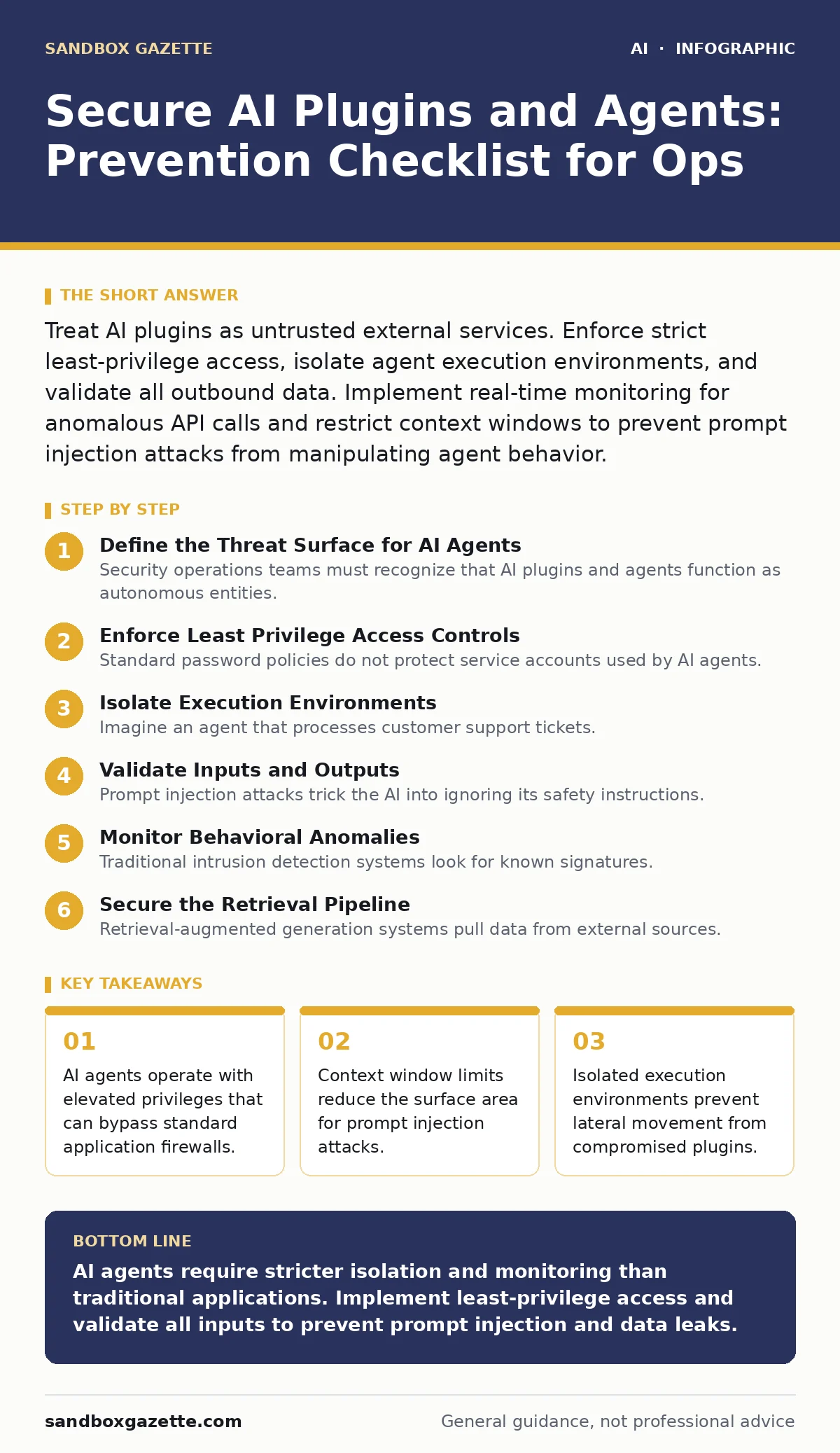
Treat AI plugins as untrusted external services. Enforce strict least-privilege access, isolate agent execution environments, and validate all outbound data. Implement real-time monitoring for anomalous API calls and restrict context windows to prevent prompt injection attacks from manipulating agent behavior.
Define the Threat Surface for AI Agents
Security operations teams must recognize that AI plugins and agents function as autonomous entities. These tools execute code, access databases, and interact with external APIs on behalf of the user. The threat model shifts from static application vulnerabilities to dynamic behavioral risks. An agent might follow instructions that appear benign but result in data exfiltration or system modification. You must map every integration point where an AI agent can read or write data.
Enforce Least Privilege Access Controls
- Assign unique service accounts for each AI agent: Prevents credential sharing and limits blast radius during compromise.
- Restrict database permissions to read-only where possible: Stops agents from modifying or deleting critical business records.
- Disable write access to configuration files: Prevents agents from altering system settings or installing new software.
- Implement role-based access control for API endpoints: Ensures agents only call functions relevant to their designated task.
- Rotate API keys regularly and store them in secrets managers: Reduces the window of opportunity for stolen credentials.
Standard password policies do not protect service accounts used by AI agents. These accounts often have persistent access. If an attacker compromises the agent, they inherit these privileges. You must treat agent credentials as high-value targets. Refer to our guide on AI risk management for frameworks on managing identity for automated systems.
Isolate Execution Environments
- Run AI agents in containerized environments: Contains malware or malicious scripts within a disposable sandbox.
- Separate agent networks from corporate LAN: Prevents lateral movement from a compromised plugin to internal servers.
- Disable outbound internet access for non-essential agents: Blocks communication with command-and-control servers.
- Use ephemeral storage for agent memory: Ensures sensitive data is wiped after the session ends.
- Monitor container resource usage for anomalies: Detects cryptomining or brute-force attempts launched by the agent.
Imagine an agent that processes customer support tickets. If it is compromised, it could scan the internal network for other vulnerable services. Network segmentation stops this spread. The agent can perform its job but cannot reach the database server directly. This isolation adds latency but significantly reduces risk.
Validate Inputs and Outputs
- Sanitize all user inputs before sending to the AI model: Prevents prompt injection attacks from altering agent behavior.
- Validate API responses for unexpected data structures: Detects manipulation or error-based information leakage.
- Implement output filtering for sensitive data patterns: Blocks credit card numbers or social security numbers from leaving the system.
- Log all agent decisions and reasoning steps: Provides audit trails for forensic analysis after an incident.
- Test agents against known prompt injection payloads: Identifies vulnerabilities before deployment to production environments.
Prompt injection attacks trick the AI into ignoring its safety instructions. An attacker might embed malicious instructions in a document the agent is supposed to summarize. The agent then executes those instructions. You must assume all external data is hostile. See our guide on prompt injection attacks for detailed mitigation strategies.
Monitor Behavioral Anomalies
- Establish baselines for normal agent API call volumes: Alerts on sudden spikes indicate abuse or compromise.
- Monitor for unusual data access patterns: Flags agents reading files outside their defined scope.
- Track token usage rates for unexpected increases: Detects potential data exfiltration via large context windows.
- Set alerts for failed authentication attempts by agents: Identifies brute-force attacks on agent credentials.
- Review logs for unauthorized changes to agent configuration: Prevents attackers from disabling security controls.
Traditional intrusion detection systems look for known signatures. AI agents generate new, dynamic traffic patterns. You need behavioral analytics to spot deviations. An agent that suddenly starts accessing HR records is behaving abnormally. This detection method complements standard security tools. Refer to AI-assisted threat detection for methods to automate this monitoring.
See also: Access Controls for AI Agents: A Practical Implementation Checklist
Secure the Retrieval Pipeline
- Implement strict access controls on vector databases: Prevents unauthorized queries or data modification.
- Validate retrieval results before feeding them to the AI: Ensures the agent acts on accurate and authorized information.
- Encrypt data at rest in the retrieval store: Protects sensitive information from disk theft or unauthorized access.
- Limit the size of retrieved context chunks: Reduces the risk of leaking sensitive data in prompts.
- Audit retrieval logs for unusual query patterns: Detects reconnaissance attempts by attackers.
Retrieval-augmented generation systems pull data from external sources. If the retrieval pipeline is insecure, the AI acts on poisoned data. Attackers can inject false information into the vector database. The agent then uses this false data to make decisions. Secure the data source as rigorously as the AI model itself. Read our guide on retrieval-augmented generation security for deeper technical controls.
Key takeaways
- AI agents operate with elevated privileges that can bypass standard application firewalls.
- Context window limits reduce the surface area for prompt injection attacks.
- Isolated execution environments prevent lateral movement from compromised plugins.
AI agents require stricter isolation and monitoring than traditional applications. Implement least-privilege access and validate all inputs to prevent prompt injection and data leaks.
Frequently asked questions
How do I prevent AI agents from leaking sensitive data?
Implement output filtering to scan for sensitive data patterns and restrict the agent's access to only the data it needs to perform its task.
What is the biggest risk of using AI plugins?
The biggest risk is prompt injection, where attackers manipulate the agent's behavior by embedding malicious instructions in input data.
Should AI agents have internet access?
Only if absolutely necessary for their function. Otherwise, block outbound internet access to prevent communication with malicious servers.
How often should I review AI agent permissions?
Review permissions quarterly or whenever the agent's function changes to ensure least-privilege access is maintained.
How this guide was produced: written by the Sandbox Gazette editorial team with AI assistance, checked against the public references listed below, and reviewed when the facts change. See our editorial policy or report an error.