
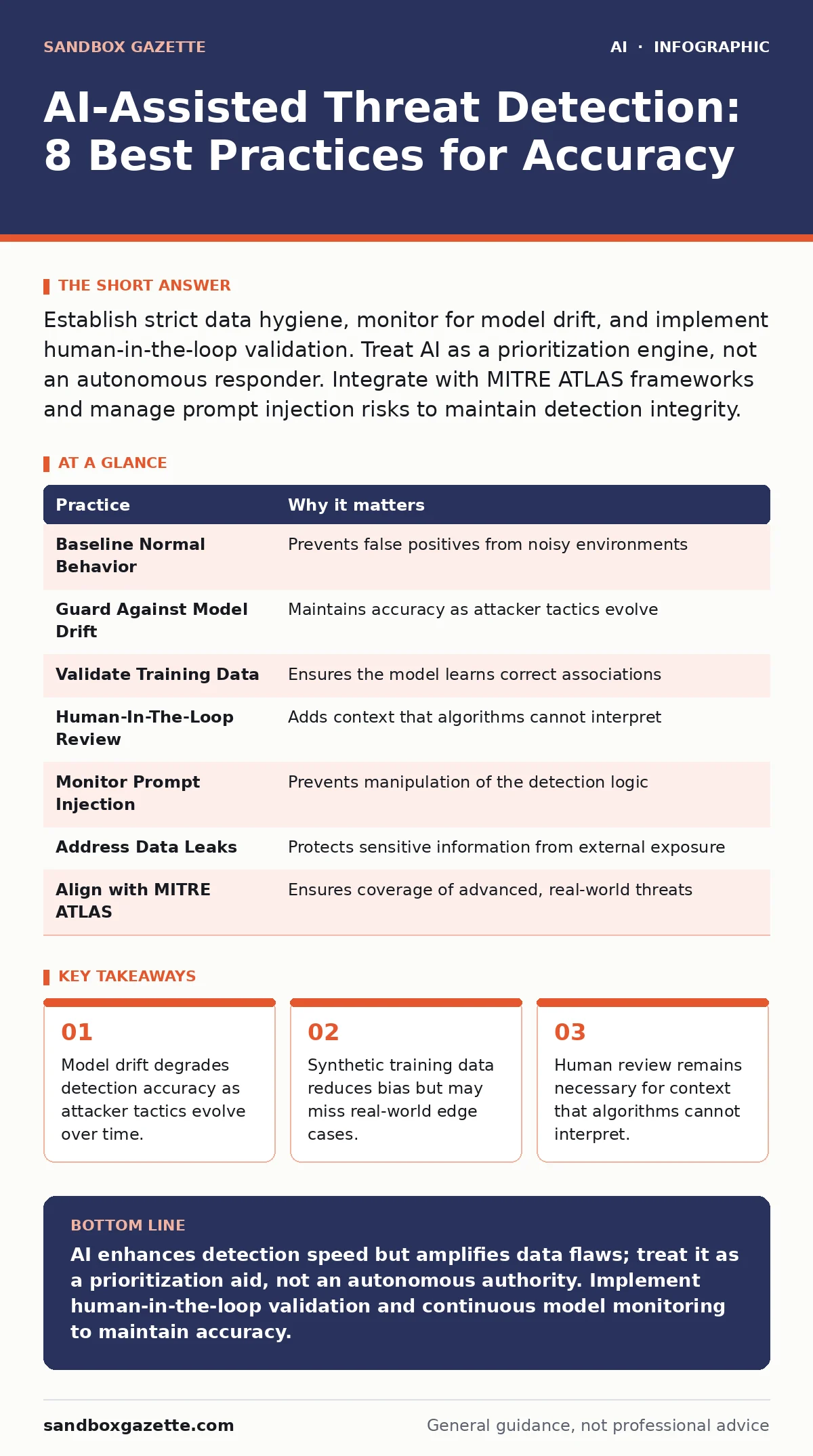
Establish strict data hygiene, monitor for model drift, and implement human-in-the-loop validation. Treat AI as a prioritization engine, not an autonomous responder. Integrate with MITRE ATLAS frameworks and manage prompt injection risks to maintain detection integrity.
1. Baseline Normal Behavior Before Detection
Machine learning models for threat detection rely on distinguishing anomalies from normal activity. If your baseline includes noisy or irrelevant traffic, the model learns to ignore threats or flag benign actions. You must define what "normal" looks like for each user, device, and application before deploying detection rules.
Practical Tip: Run your detection engine in passive monitoring mode for several weeks. Collect logs without generating alerts to establish a clean statistical baseline of typical behavior patterns.
2. Guard Against Model Drift
Adversaries change their tactics to evade detection, causing the statistical distribution of your data to shift. This phenomenon, known as model drift, means a model trained on last year’s data may fail to recognize this year’s attacks. Without continuous retraining, your detection capabilities decay silently.
Practical Tip: Implement automated alerts for performance degradation. If the false positive rate spikes or detection latency increases, trigger a review of the training data and model parameters.
3. Validate Training Data Quality
Garbage in, garbage out applies strictly to AI. If your historical logs contain mislabeled events, the model learns incorrect associations. For example, if internal scanning tools were previously labeled as attacks, the model will flag all internal scans as malicious. Clean, accurately labeled data is the foundation of reliable detection.
Practical Tip: Audit a random sample of training data monthly. Verify that labels match the actual security event and correct any misclassifications before retraining the model.
4. Integrate Human-In-The-Loop Review
Automated systems lack context. An AI might flag a sudden data transfer as exfiltration, but a human analyst knows it is a scheduled backup. Purely automated responses can disrupt business operations and create alert fatigue. Human analysts provide the nuance required to distinguish between a threat and a benign anomaly.
Practical Tip: Configure your system to require human approval for any high-severity automated response. Use the AI to prioritize alerts, not to execute containment actions without verification.
5. Monitor for Prompt Injection Risks
Large language models used in security operations can be manipulated through prompt injection attacks. An attacker might embed malicious instructions in data logs or email bodies to trick the AI into ignoring threats or revealing sensitive information. You must treat untrusted input to AI models as a potential attack vector.
Practical Tip: Sanitize all input data before feeding it to the model. Use separate processing pipelines for trusted system logs and untrusted user-generated content to prevent cross-contamination.
See also: Endpoint Telemetry FAQs: What Agents Actually See · SIEM Explained: How Log Aggregation Stops Silent Breaches
6. Address Sensitive Data Leaks Through AI Chatbots
Security teams often use AI chatbots to query logs or summarize incidents. If these tools are not properly isolated, they may expose sensitive data to external servers or unauthorized users. Sensitive data leaks through AI chatbots occur when context windows are not cleared or when logs are used for model training.
Practical Tip: Disable data retention and training features on any commercial AI tools used for security analysis. Ensure that all interactions occur within a closed, air-gapped environment if possible.
7. Align with MITRE ATLAS Frameworks
Traditional detection rules often miss advanced, persistent threats. The MITRE ATLAS framework provides a comprehensive list of tactics and techniques used by adversaries. Aligning your AI detection models with this framework ensures you are testing for specific, real-world attack patterns rather than generic anomalies.
Practical Tip: Map your AI detection capabilities to specific MITRE ATLAS techniques. Identify gaps where the model lacks training data for certain attack vectors and prioritize collecting that data.
8. Ensure AI Transparency in Decisions
Black-box models make decisions that are difficult to explain. When an AI flags an event as malicious, you need to know why. Lack of transparency makes it hard to validate alerts, debug false positives, and trust the system. AI transparency allows analysts to understand the reasoning behind each detection.
Practical Tip: Use models that provide feature importance scores. These scores indicate which data points contributed most to the decision, allowing analysts to verify the logic behind the alert.
| Practice | Why it matters |
|---|---|
| Baseline Normal Behavior | Prevents false positives from noisy environments |
| Guard Against Model Drift | Maintains accuracy as attacker tactics evolve |
| Validate Training Data | Ensures the model learns correct associations |
| Human-In-The-Loop Review | Adds context that algorithms cannot interpret |
| Monitor Prompt Injection | Prevents manipulation of the detection logic |
| Address Data Leaks | Protects sensitive information from external exposure |
| Align with MITRE ATLAS | Ensures coverage of advanced, real-world threats |
| Ensure AI Transparency | Enables validation and debugging of alerts |
9. Test With Synthetic Attack Data
Real-world attacks are rare and unpredictable. Relying solely on historical data limits your model’s ability to detect novel threats. Synthetic data allows you to simulate specific attack scenarios and test the model’s response without risking production systems. This approach helps identify weaknesses in the detection logic.
Practical Tip: Generate synthetic logs that mimic specific attack patterns from the OWASP Top 10 for LLM applications. Use these logs to stress-test your model and measure its detection capabilities.
10. Manage Retrieval-Augmented Generation Security
If you use retrieval-augmented generation to answer security questions, the system retrieves external data to inform its responses. If the retrieval source is compromised, the AI may provide incorrect or malicious advice. You must secure the retrieval pipeline to ensure the integrity of the information used by the model.
Practical Tip: Implement strict access controls on the knowledge base used for retrieval. Regularly audit the sources to ensure they are trustworthy and up-to-date.
11. Continuously Monitor for Training Data Leakage
Training data leakage occurs when sensitive information from the training set appears in the model’s outputs. This can happen if the model memorizes specific data points rather than learning general patterns. You must monitor model outputs for unexpected data exposure.
Practical Tip: Use differential privacy techniques during training. This adds noise to the data, preventing the model from memorizing specific records while still learning general trends.
Key takeaways
- Model drift degrades detection accuracy as attacker tactics evolve over time.
- Synthetic training data reduces bias but may miss real-world edge cases.
- Human review remains necessary for context that algorithms cannot interpret.
AI enhances detection speed but amplifies data flaws; treat it as a prioritization aid, not an autonomous authority. Implement human-in-the-loop validation and continuous model monitoring to maintain accuracy.
Frequently asked questions
How do I know if my AI model is suffering from drift?
Look for sudden changes in false positive rates or detection latency. If the model’s performance metrics degrade without changes to the code, drift is likely occurring.
Can AI replace human security analysts?
No. AI lacks context and nuance. It can prioritize alerts and identify patterns, but human judgment is required for complex decisions and incident response.
What is the biggest risk of using AI in threat detection?
The biggest risk is over-reliance on the model. If the model fails or is manipulated, and humans do not verify its outputs, threats may go undetected or cause unnecessary disruption.
How often should I retrain my detection models?
Retraining frequency depends on your environment’s volatility. In high-risk environments, monthly retraining may be necessary. Monitor performance metrics to determine the optimal schedule.
How this guide was produced: written by the Sandbox Gazette editorial team with AI assistance, checked against the public references listed below, and reviewed when the facts change. See our editorial policy or report an error.