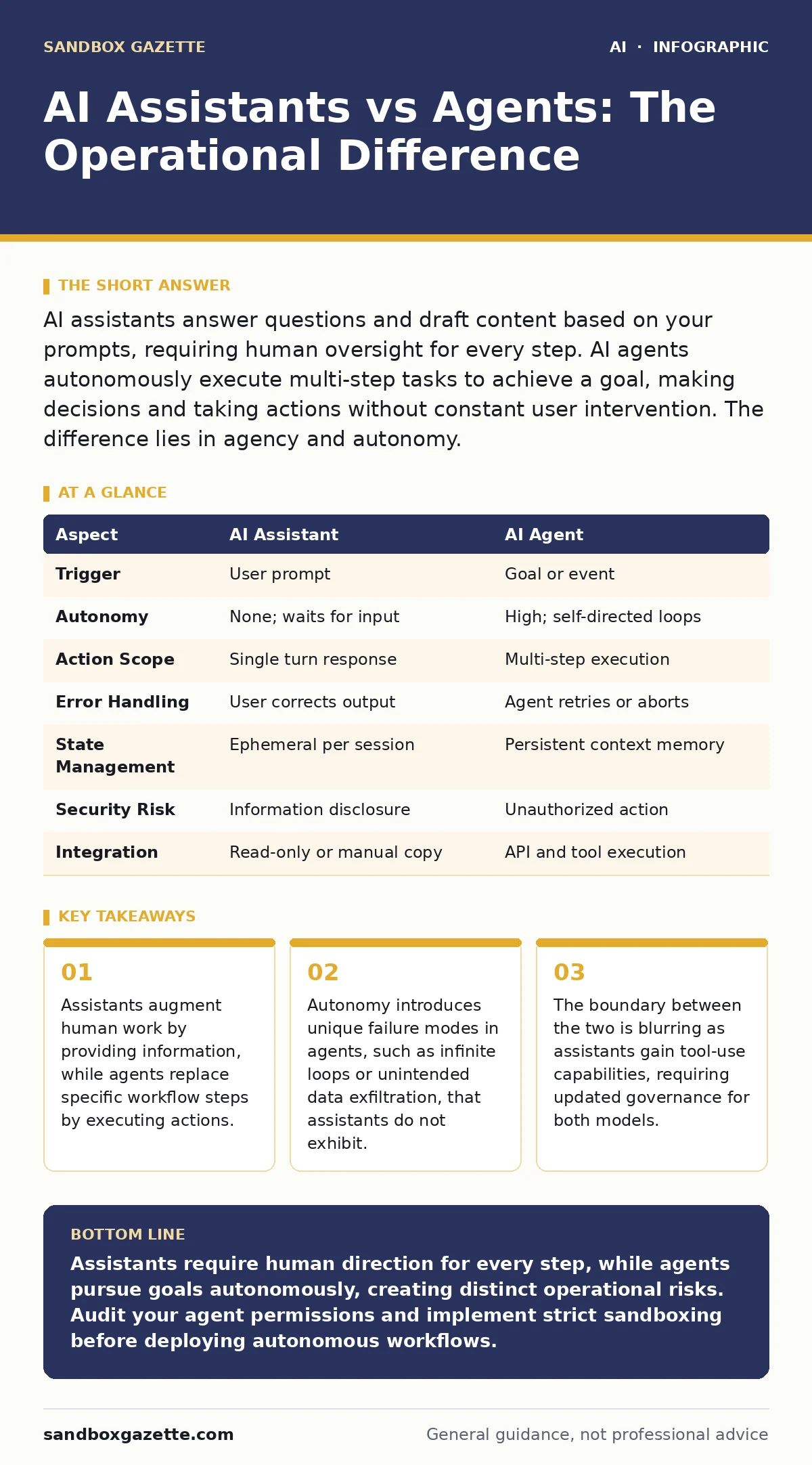
AI assistants answer questions and draft content based on your prompts, requiring human oversight for every step. AI agents autonomously execute multi-step tasks to achieve a goal, making decisions and taking actions without constant user intervention. The difference lies in agency and autonomy.
The Core Distinction: Input Versus Outcome
The fundamental difference between an AI assistant and an AI agent is the degree of autonomy granted to the system. An assistant operates reactively. You provide a prompt, and the model generates a response. It waits for your next instruction. It does not initiate actions, call external APIs, or modify system state unless you explicitly command it to do so within a single turn.
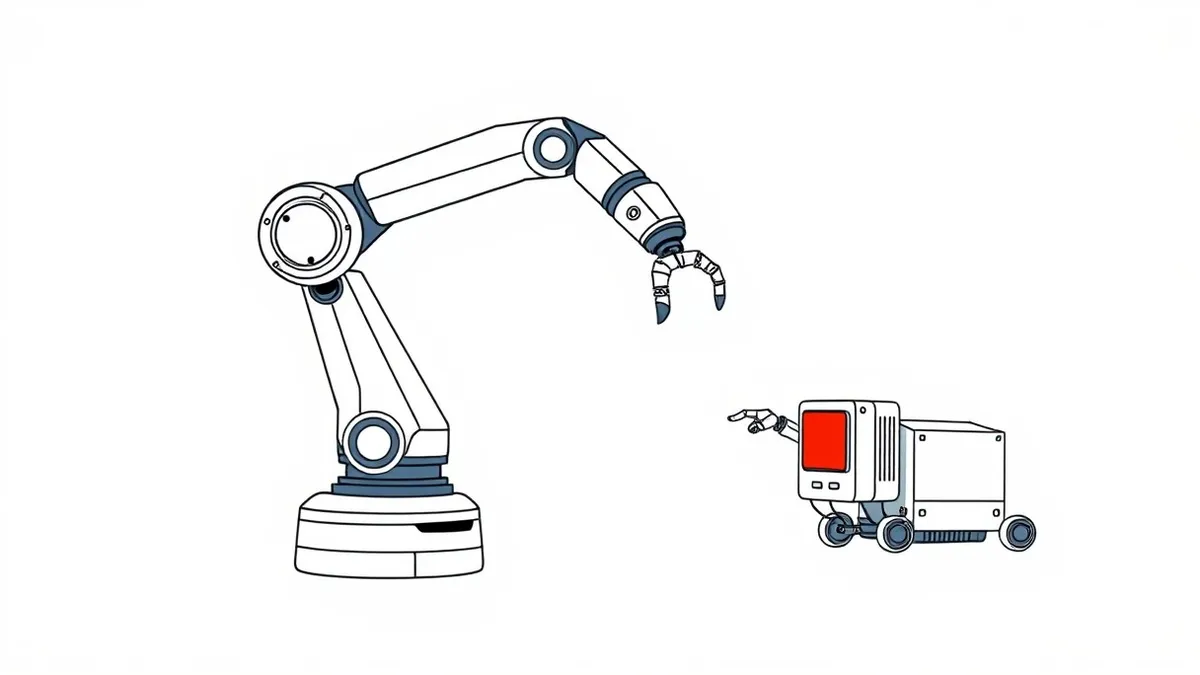
An agent operates proactively. You provide a goal, and the model plans a sequence of steps to achieve it. It breaks the objective down, calls tools, evaluates the results, and iterates. It acts as a worker, not a consultant. This shift from reactive text generation to proactive task execution changes the security posture entirely.
Understanding the Assistant Model
An AI assistant is essentially a sophisticated pattern matcher and generator. It excels at synthesizing information, drafting emails, or writing code snippets. The model relies on your context window and your specific instructions. It has no memory of previous interactions beyond what you include in the prompt or what the application provides via context.
Because assistants do not take autonomous actions, the attack surface is limited to the input and output. You must guard against prompt injection in the input and sensitive data leaks through AI chatbots in the output. The system cannot accidentally delete a database because it lacks the agency to execute that command without your direct trigger.
Understanding the Agent Model
An AI agent possesses a control loop. It perceives the environment, reasons about the next step, takes an action, and observes the result. This cycle repeats until the goal is met or a failure condition is triggered. Agents can use search engines, write code to a repository, or send messages to other services.
This autonomy creates a hidden cost: the complexity of debugging. When an agent fails, it is often difficult to trace why it chose a specific path. The model may have misinterpreted an API response or fallen into a logic loop. Unlike assistants, agents can cause collateral damage by acting on incorrect assumptions with real-world consequences.
Point-by-Point Comparison
| Aspect | AI Assistant | AI Agent |
|---|---|---|
| Trigger | User prompt | Goal or event |
| Autonomy | None; waits for input | High; self-directed loops |
| Action Scope | Single turn response | Multi-step execution |
| Error Handling | User corrects output | Agent retries or aborts |
| State Management | Ephemeral per session | Persistent context memory |
| Security Risk | Information disclosure | Unauthorized action |
| Integration | Read-only or manual copy | API and tool execution |
Where the Boundaries Blur
The line between assistant and agent is not static. Many modern assistants now include "tool use" capabilities, allowing them to call a single function, such as a weather API or a calculator. This is a limited form of agency. However, these systems still require explicit user approval for each tool call.
True agents operate without that stopgap. They may call ten APIs in sequence to book a flight, only asking for payment authorization at the end. As models improve, you will see more assistants adopting agentic behaviors. This convergence demands that you apply agent-level security controls to any assistant that can interact with external systems.
See also: Emergency Stop for AI Systems: 8 Critical Questions Answered · Exposed AI Model Servers: Secure Your Endpoints and APIs
Choosing the Right Architecture
Choose the assistant when:
- The task requires high accuracy and human verification.
- The output is informational, such as summarizing logs or drafting reports.
- The risk of unintended action is unacceptable.
- You need to maintain strict audit trails of human decisions.
Choose the agent when:
- The task is repetitive, structured, and low-risk.
- Speed and automation outweigh the need for real-time human oversight.
- The environment is sandboxed or has strict guardrails.
- You have robust monitoring for machine learning for fraud detection or anomalous behavior.
Security Implications for Operations
Agents introduce the risk of data poisoning attacks more acutely than assistants. If an agent reads from a compromised data source, it may propagate poisoned instructions to other systems. You must treat the agent's environment as potentially hostile.
Implement strict least-privilege access for agent identities. An agent should only have permissions to perform its specific task, not broad administrative rights. Monitor for shadow AI usage, where employees deploy personal agents on corporate data. These unvetted agents often lack the security controls of enterprise-grade systems.
Key takeaways
- Assistants augment human work by providing information, while agents replace specific workflow steps by executing actions.
- Autonomy introduces unique failure modes in agents, such as infinite loops or unintended data exfiltration, that assistants do not exhibit.
- The boundary between the two is blurring as assistants gain tool-use capabilities, requiring updated governance for both models.
Assistants require human direction for every step, while agents pursue goals autonomously, creating distinct operational risks. Audit your agent permissions and implement strict sandboxing before deploying autonomous workflows.
Frequently asked questions
Can an AI assistant become an agent over time?
Yes, if the application architecture adds tool-use capabilities and autonomous planning loops to the underlying model, effectively granting it agency.
Are AI agents more accurate than assistants?
Not necessarily. Agents can compound errors across multiple steps, leading to lower overall accuracy if intermediate outputs
How this guide was produced: written by the Sandbox Gazette editorial team with AI assistance, checked against the public references listed below, and reviewed when the facts change. See our editorial policy or report an error.