
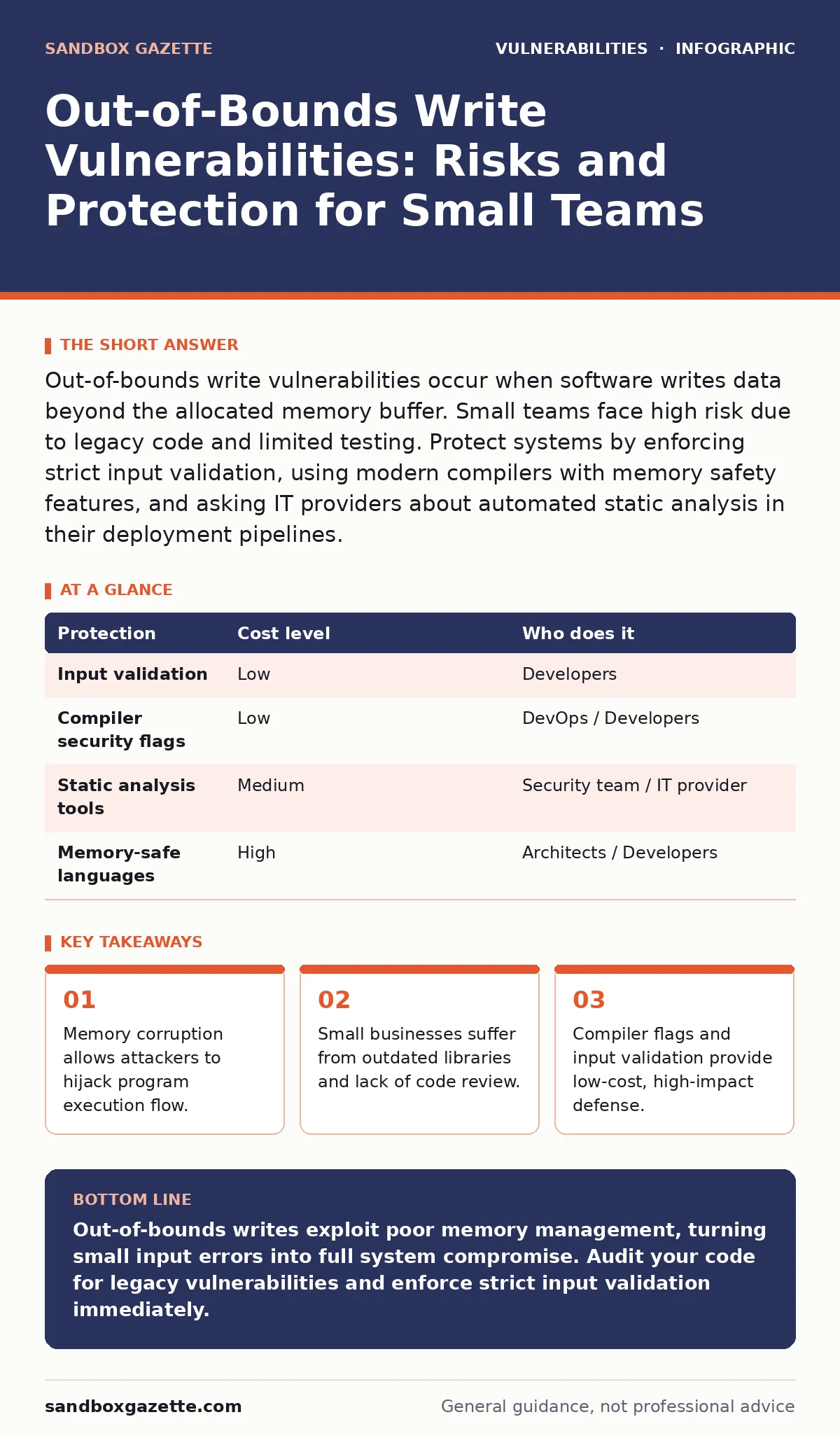
Out-of-bounds write vulnerabilities occur when software writes data beyond the allocated memory buffer. Small teams face high risk due to legacy code and limited testing. Protect systems by enforcing strict input validation, using modern compilers with memory safety features, and asking IT providers about automated static analysis in their deployment pipelines.
Why Small Organizations Face Disproportionate Risk
Small organizations often assume that size provides stealth. Attackers target large enterprises for ransom, but small teams are attractive for initial access. You likely rely on third-party software or custom scripts that lack rigorous security testing. These components often contain out-of-bounds write vulnerabilities. These flaws happen when a program writes data to a memory location outside its intended buffer. The operating system does not always catch this error immediately. Instead, the corrupted memory sits silently until a specific condition triggers execution.
Legacy code is a primary vector. You may be using software written years ago by a developer who no longer works for your company. That code was written before modern memory safety standards existed. It likely lacks bounds checking. When you update the operating system, the application remains unchanged. The mismatch between modern OS protections and old application logic creates gaps. These gaps allow attackers to bypass standard defenses.
Another hidden cost is the reliance on open-source libraries. Many small teams copy code snippets from online forums. These snippets often include dependencies that are no longer maintained. If a dependency has a known vulnerability, your application inherits it. You cannot patch the library directly. You must update the entire application or replace the library. This process requires time and expertise that small teams often lack.
The Mechanics of Memory Corruption
Understanding the mechanism helps you appreciate the risk. Computer memory is divided into blocks. Each block has a specific size and purpose. An out-of-bounds write occurs when the program fails to verify the size of the input data. It writes the data into the buffer. When the data exceeds the buffer size, it spills over. This overflow overwrites adjacent memory locations.
These adjacent locations often contain critical program data. They might hold return addresses, function pointers, or security flags. Overwriting a return address changes where the program jumps after a function finishes. An attacker can craft input that places executable code in the overflowed memory. When the program jumps to the overwritten address, it executes the attacker’s code. This grants the attacker control over the process.
Heap overflow vulnerabilities are a specific type of this flaw. The heap is a region of memory used for dynamic allocation. Unlike the stack, the heap is more complex to manage. Errors in heap management are harder to detect and exploit. They often require precise timing and specific memory layouts. However, once exploited, they can lead to persistent backdoors. You should understand that stack and heap protections are different. One defense does not cover the other.
Low-Cost Protections for Limited Budgets
You do not need expensive security tools to mitigate these risks. The most effective protections are built into the development process. Enforcing strict input validation is the first line of defense. Every piece of data entering your application must be checked for length and format. Reject data that does not match the expected schema. This prevents the overflow from occurring in the first place.
Use modern compilers with security features enabled. Compilers like GCC and Clang offer flags that detect potential buffer overflows at compile time. Enable Address Sanitizer (ASan) during testing. This tool instruments the code to detect memory errors at runtime. It slows down performance, so use it only in test environments. It catches out-of-bounds writes before they reach production.
Regular expression denial of service (ReDoS) is a different issue, but both stem from poor input handling. Treating input validation as a holistic practice helps. If you validate for length, you also validate for content. This dual approach reduces the attack surface. You should also review your dependency management. Use tools that scan your libraries for known vulnerabilities. Update dependencies regularly. This prevents you from inheriting old, unpatched code.
| Protection | Cost level | Who does it |
|---|---|---|
| Input validation | Low | Developers |
| Compiler security flags | Low | DevOps / Developers |
| Static analysis tools | Medium | Security team / IT provider |
| Memory-safe languages | High | Architects / Developers |
What to Ask Your IT Provider
If you outsource your IT, you must verify their security practices. Many providers focus on network security and ignore application code. You need to ensure they address memory safety. Ask specific questions about their development lifecycle. Do not accept vague answers about "best practices." You need concrete evidence of their processes.
Ask if they use static application security testing (SAST). This tool analyzes source code for vulnerabilities without running it. It can detect out-of-bounds write patterns. Ask how often they run these scans. Continuous integration pipelines should run them automatically. Ask if they review the results. Scans produce false positives. Human review is necessary to fix real issues.
Ask about their dependency management strategy. Do they use a software bill of materials (SBOM)? This lists all components in your application. It helps you track vulnerabilities in third-party libraries. Ask if they monitor for dependency confusion attacks. These attacks trick build systems into pulling malicious packages. A clear supply chain strategy protects you from upstream risks.
Ask if they train developers on secure coding. Technical tools are not enough. Developers must understand why bounds checking matters. Ask for examples of recent security training. Ask if they conduct code reviews focused on security. Peer review catches errors that automated tools miss.
The Hidden Cost of Legacy Systems
Many small teams keep old systems running because replacement is expensive. This is a false economy. Legacy systems often lack modern memory protection mechanisms. They may run on outdated operating systems that no longer receive security updates. When a vulnerability is discovered, there is no patch. You are left exposed.
The cost of a breach far exceeds the cost of migration. An out-of-bounds write can lead to data theft or system compromise. The downtime and recovery efforts are significant. You should calculate the true cost of maintaining legacy code. Include the risk of exploitation in your budget. Plan for gradual migration to modern, memory-safe technologies.
Consider the complexity of vulnerability chaining. Attackers rarely use a single flaw. They combine multiple weaknesses to bypass defenses. An out-of-bounds write might be the final step. It requires an initial foothold. If you ignore memory safety, you make the final step easier for attackers. You must defend at every layer.
See also: Regular Expression Denial of Service: 6 Myths That Hide Real Risk
Building a Resilient Culture
Security is not just a technical problem. It is a cultural one. Your team must prioritize code quality over speed. Rushing releases introduces errors. Out-of-bounds writes often result from hurried coding. Encourage thorough testing. Reward developers who find and fix vulnerabilities. Create a safe environment for reporting issues.
Coordinate with your team on coordinated vulnerability disclosure. This process allows researchers to report flaws responsibly. It gives you time to patch before the public knows. It builds trust and reduces reputational damage. Establish clear channels for reporting. Make it easy for anyone to report a security concern.
Prototype pollution is another risk in JavaScript environments. It affects how objects are structured in memory. While different from C-style buffer overflows, it shows the importance of memory safety across languages. You must adapt your defenses to the languages you use. There is no one-size-fits-all solution.
Summary of Actions
Start by auditing your current software. Identify legacy applications and custom scripts. Prioritize those that handle external input. Implement strict input validation. Enable compiler security flags. Train your developers. Ask your IT provider the right questions. These steps reduce your risk significantly. They do not eliminate it, but they raise the bar for attackers.
HTTP security headers provide another layer of defense. They control how browsers interact with your servers. They do not fix code flaws, but they limit the impact of some attacks. Use them as part of a broader strategy. Combine them with input validation and memory safety. This layered approach provides the best protection.
Key takeaways
- Memory corruption allows attackers to hijack program execution flow.
- Small businesses suffer from outdated libraries and lack of code review.
- Compiler flags and input validation provide low-cost, high-impact defense.
Out-of-bounds writes exploit poor memory management, turning small input errors into full system compromise. Audit your code for legacy vulnerabilities and enforce strict input validation immediately.
Frequently asked questions
How do I know if my software has an out-of-bounds write vulnerability?
You cannot know for certain without code review. Use static analysis tools and fuzz testing to find potential issues. Look for crashes or unexpected behavior when processing large inputs.
Can antivirus software stop out-of-bounds write attacks?
No. Antivirus scans for known malware signatures. Memory corruption attacks often inject new code at runtime. You need application-level defenses like input validation and compiler protections.
Is migrating to a memory-safe language expensive?
Initial migration costs are high. However, long-term maintenance costs drop significantly. You reduce the need for complex debugging and patching. Plan for a gradual transition to minimize disruption.
What is the difference between a stack overflow and a heap overflow?
Stack overflows affect local variables and return addresses. Heap overflows affect dynamically allocated memory. Heap overflows are harder to detect and exploit but can lead to more persistent control.
How this guide was produced: written by the Sandbox Gazette editorial team with AI assistance, checked against the public references listed below, and reviewed when the facts change. See our editorial policy or report an error.