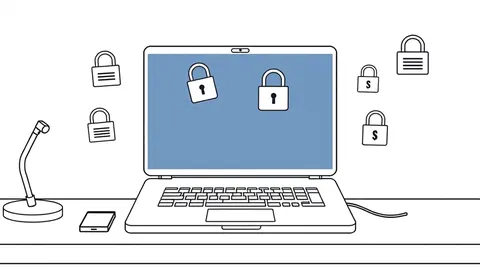
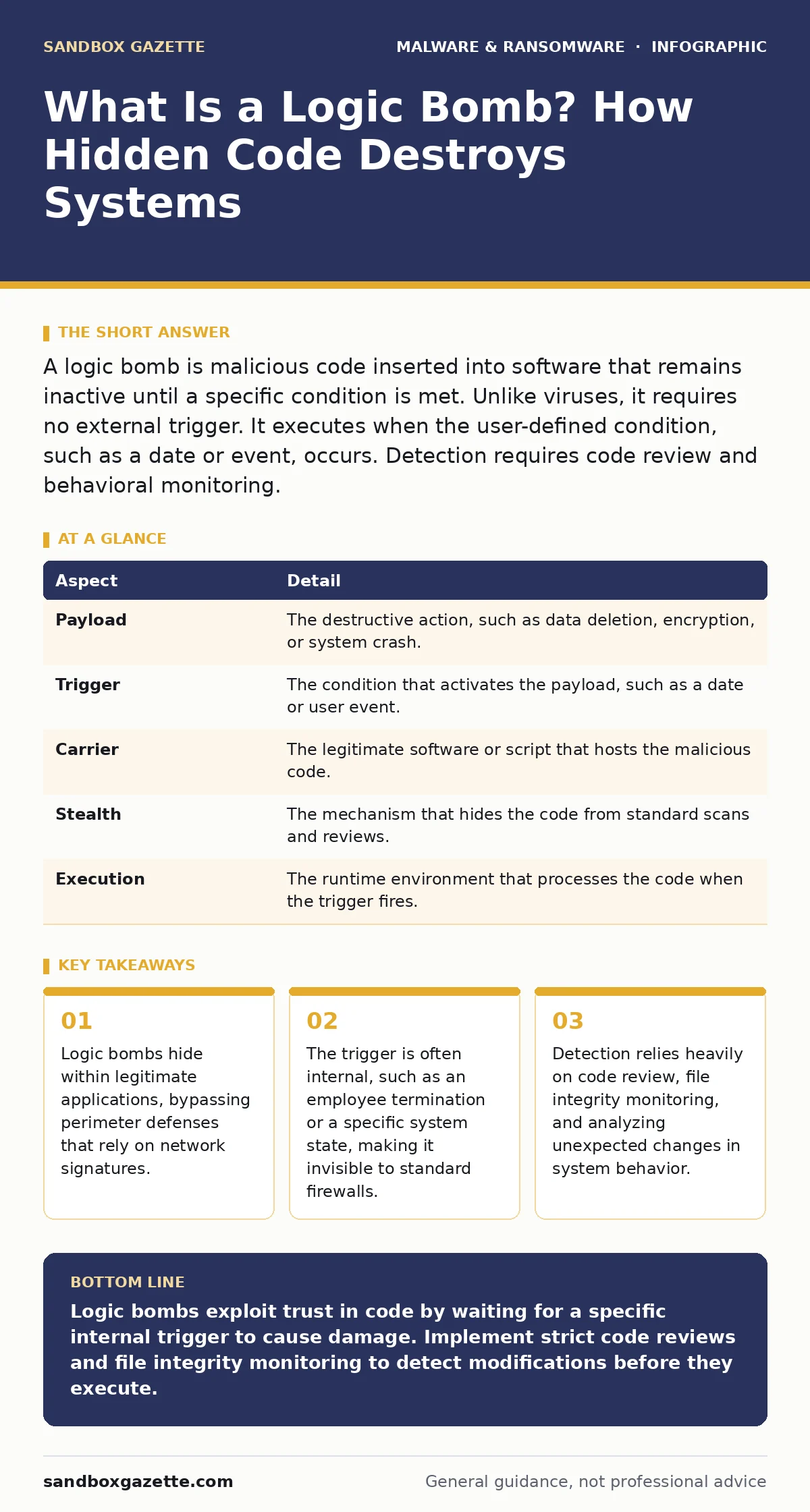
A logic bomb is malicious code inserted into software that remains inactive until a specific condition is met. Unlike viruses, it requires no external trigger. It executes when the user-defined condition, such as a date or event, occurs. Detection requires code review and behavioral monitoring.
The Time Bomb in the Code
Imagine a security guard who has worked at a facility for ten years. He knows every blind spot and every password. One day, he decides to sabotage the building. Instead of smashing the windows, he programs the alarm system to trigger only when a specific manager clocks out. For months, nothing happens. The system appears normal. Then, the condition is met, and chaos ensues.
This is the core mechanism of a logic bomb. It is a piece of malicious code inserted into a software application or script. It does not activate immediately. It waits for a predefined condition to occur. This condition can be a date, a time, a specific user action, or even the absence of an action.
The danger lies in its stealth. Traditional antivirus software often scans for known signatures of malicious behavior. A logic bomb, however, sits quietly within code that may be signed, trusted, or internal. It does not communicate with command-and-control servers until it is ready to strike. This breaks the assumption that all malware must "phone home" to function.
Anatomy of a Trigger
At a glance, understanding the components helps in identifying where to look for these threats.
| Aspect | Detail |
|---|---|
| Payload | The destructive action, such as data deletion, encryption, or system crash. |
| Trigger | The condition that activates the payload, such as a date or user event. |
| Carrier | The legitimate software or script that hosts the malicious code. |
| Stealth | The mechanism that hides the code from standard scans and reviews. |
| Execution | The runtime environment that processes the code when the trigger fires. |
The payload is what causes the damage. It might wipe a database, encrypt files for ransom, or simply crash a server. The trigger is the "if" statement in the code. If the trigger is IF date == 12/31, the code does nothing until that date. If the trigger is IF user == "admin", it activates when that specific account logs in.
The carrier is often trusted. An employee might insert a logic bomb into a payroll script. A developer might embed it in a library used by multiple applications. Because the carrier is legitimate, it passes initial security checks. The stealth aspect ensures the malicious lines of code are obfuscated or blended with normal logic. This makes static analysis difficult. You are looking for a needle in a haystack that looks like hay.
Common Forms and Vectors
Logic bombs rarely arrive as standalone files. They are embedded. The most common vector is insider threat. A disgruntled employee with write access to source code can insert the bomb before leaving. They know the system well enough to hide it where it will not be noticed immediately.
Another vector is trojanized software. Attackers compromise the build pipeline of a legitimate application. They inject the logic bomb during compilation. When users download and install the update, they are installing the bomb. This bypasses many security controls because the application signature remains valid.
Supply chain attacks also use this method. A third-party library is compromised. Any application using that library inherits the logic bomb. This amplifies the impact. You do not need to hack every system individually. You only need to compromise one shared component.
Remote access tools can also be used to deploy logic bombs. An attacker gains access via remote access tool abuse. They do not steal data immediately. Instead, they plant a dormant script. They leave the environment. Weeks later, they send a signal, or the internal trigger fires. This disconnects the attack from the initial intrusion, complicating forensic analysis.
Who Gets Burned
Any organization using software is at risk. However, the impact varies. Financial institutions are frequent targets because logic bombs can disrupt transaction systems at peak times. Healthcare providers face risks when logic bombs affect patient record systems. Manufacturing plants suffer when logic bombs disrupt control systems.
The key factor is trust. Logic bombs exploit the trust placed in internal code and third-party vendors. If you trust an application, you assume it behaves as documented. A logic bomb violates that assumption. It behaves normally until the trigger. This makes it particularly effective against organizations that rely heavily on proprietary software or custom scripts.
Individuals are less targeted, but not immune. A freelance developer might include a logic bomb in a script sold to a client. If the client fails to pay, the code might delete the project files. This is a malicious form of digital rights management. It is illegal and destructive, but it demonstrates the versatility of the technique.
What People Usually Get Wrong
Many security teams assume that logic bombs are rare. This is a dangerous misconception. They are common in insider threat scenarios. The misconception stems from visibility. Most logic bombs are discovered during routine audits or after a failure. They are not detected by intrusion detection systems because they do not involve network traffic anomalies during the dormant phase.
Another mistake is relying solely on antivirus. Antivirus engines look for known bad patterns. A logic bomb is often custom-written. It has no known signature. It looks like normal code until it executes. Even then, if the execution is slow or incremental, it may not trigger alerts.
Teams also underestimate the role of software restriction policies. These policies control which applications can run. If a logic bomb is embedded in a trusted application, restriction policies may not stop it. The application is allowed to run, so its malicious child processes are also allowed. This creates a blind spot. You restrict the unknown, but the known becomes the weapon.
Finally, there is a belief that sandboxing solves the problem. Sandboxing isolates applications to prevent them from affecting the host system. While this limits damage, it does not prevent the logic bomb from executing. If the sandboxed application has access to shared data or networks, the bomb can still cause harm. It just limits the blast radius. It does not remove the bomb.
See also: What Is Remote Browser Isolation: Architecture, Trade-offs, and Deployment
Reducing the Risk
You cannot scan for intent. You must control access and monitor behavior. The first step is strict code review. Every line of code added to production should be reviewed by a second developer. This is tedious, but it catches anomalies. Look for code that does not match the feature set. Look for hard-coded dates or unusual conditional statements.
Implement file integrity monitoring. This tracks changes to critical files. If a trusted application is modified, the system alerts you. This detects the insertion of the logic bomb. It does not detect the execution, but it gives you time to intervene. Combine this with version control. Every change should be logged. If a file changes without a corresponding commit, that is a red flag.
Limit privileges. Use the principle of least privilege. Developers should not have write access to production environments. This prevents insiders from planting bombs directly. Use build pipelines that compile code from secure repositories. This ensures that the code running in production is the same code that was reviewed.
Monitor for unusual behavior. Business continuity planning should include scenarios where critical systems fail due to internal sabotage. Have runbooks for rapid isolation. If a database starts dropping tables, the response should be immediate. Automate the detection of mass data deletion. This allows you to cut the power before the damage is complete.
The Hidden Cost of Trust
The hardest part of defending against logic bombs is managing trust. You must assume that any code could be compromised. This requires a cultural shift. It moves security from the perimeter to the codebase. It requires developers to understand security implications. It requires operations teams to monitor for subtle changes.
There is a trade-off. Strict code review slows down development. File integrity monitoring generates noise. You must balance security with agility. However, the cost of a logic bomb detonation is far higher. It can destroy data, halt operations, and erode customer trust. The effort to prevent it is an investment in stability.
Remember that ransomware incident response plans often fail against logic bombs. Ransomware encrypts files and demands payment. Logic bombs may just delete files. There is no negotiation. There is no decryption key. The data is gone. This makes prevention the only viable defense. You must stop the bomb from being planted or detect it before it triggers.
Key takeaways
- Logic bombs hide within legitimate applications, bypassing perimeter defenses that rely on network signatures.
- The trigger is often internal, such as an employee termination or a specific system state, making it invisible to standard firewalls.
- Detection relies heavily on code review, file integrity monitoring, and analyzing unexpected changes in system behavior.
Logic bombs exploit trust in code by waiting for a specific internal trigger to cause damage. Implement strict code reviews and file integrity monitoring to detect modifications before they execute.
Frequently asked questions
Can antivirus software detect a logic bomb?
Only if the specific code signature is already known to the antivirus vendor. Custom logic bombs usually bypass signature-based detection because they appear as normal code until activated.
How do I know if my system has a logic bomb?
You likely will not know until it triggers. Focus on preventive measures like code reviews and integrity monitoring. Sudden, unexplained system failures or data loss are often the first signs of execution.
Are logic bombs only used by insiders?
No. External attackers can inject logic bombs via supply chain compromises or by exploiting vulnerabilities to modify existing applications. The key is unauthorized modification of trusted code.
Does updating software remove logic bombs?
Only if the update replaces the compromised files. If the build process remains compromised, new updates may also contain the logic bomb. Verify the integrity of your build pipeline.
How this guide was produced: written by the Sandbox Gazette editorial team with AI assistance, checked against the public references listed below, and reviewed when the facts change. See our editorial policy or report an error.