Business continuity planning defines how an organization maintains critical operations during disruptions. It moves beyond security controls to focus on recovery time, data integrity and service availability. This framework ensures the business survives events that bypass technical defenses.
The Umbrella Analogy
Imagine walking in the rain. An umbrella keeps you dry, but it does not stop the storm. If the wind breaks the umbrella, you still need a coat or a way to get home. Technical security tools are the umbrella. They block many threats. Business continuity planning is the coat. It protects you when the umbrella fails.
Most organizations invest heavily in the umbrella. They buy firewalls, endpoint protection and monitoring tools. This is wise. However, no defense is perfect. When a threat bypasses these layers, the storm hits. Without a plan for what happens next, operations stop. The plan ensures you keep moving, even if you are wet.
Defining the Core Mechanism
Business continuity planning is the process of identifying critical business functions and establishing methods to maintain them during a disruption. It is not a technical fix. It is an operational strategy. The purpose is to minimize downtime and data loss.
This differs from disaster recovery. Disaster recovery focuses on restoring IT infrastructure. You bring servers back online. You restore databases from backups. Business continuity is broader. It asks how the business continues without those servers. Can staff work from home? Can you use paper processes? Can you switch to a manual workflow?
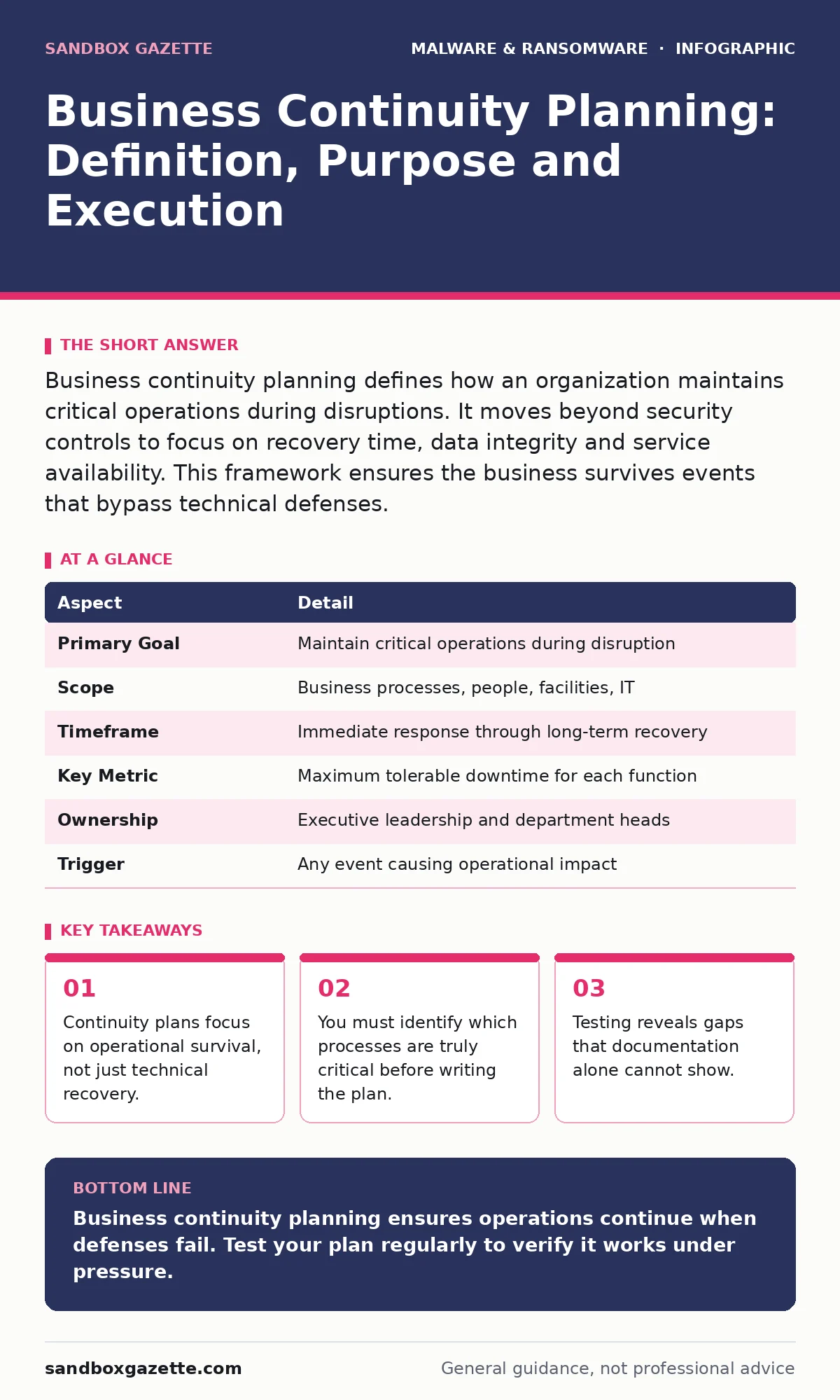
| Aspect | Detail |
|---|---|
| Primary Goal | Maintain critical operations during disruption |
| Scope | Business processes, people, facilities, IT |
| Timeframe | Immediate response through long-term recovery |
| Key Metric | Maximum tolerable downtime for each function |
| Ownership | Executive leadership and department heads |
| Trigger | Any event causing operational impact |
The Problem It Solves
Technical controls reduce the likelihood of an incident. They do not eliminate it. Sophisticated attacks often evade detection. Supply chain compromises, such as trojanized software, can infiltrate systems before you see them. Insider threats bypass perimeter defenses entirely.
When these events occur, the immediate problem is not just the breach. It is the halt of revenue-generating activities. Orders stop. Support tickets pile up. Employees cannot access tools. The business continuity plan solves the problem of operational paralysis. It provides a predefined path to keep essential services running.
Consider the difference between having a backup and having a plan. A backup restores data. It does not tell you which data to restore first. It does not tell you who has authority to make decisions. It does not tell you how to communicate with customers while systems are down. The plan fills those gaps.
Main Components of the Plan
A functional plan rests on three pillars. The first is the business impact analysis. This exercise identifies which processes are critical. You determine the maximum time each function can be down before the business suffers unacceptable harm. This is called the maximum tolerable downtime.
The second pillar is the recovery strategy. For each critical function, you define how it will continue. This might involve switching to a secondary site. It might mean using a manual workaround. It might require temporary staffing changes. The strategy must be realistic. It must account for resource constraints.
The third pillar is the response team. You designate who makes decisions. You define communication channels. You list external contacts. During a crisis, clarity of authority prevents chaos. If everyone tries to lead, no one leads. If no one knows who leads, confusion spreads.
Integration with Other Defenses
Business continuity planning does not exist in a vacuum. It must align with incident response. Incident response focuses on containing the threat. Business continuity focuses on maintaining operations. These goals can conflict.
For instance, incident response may require shutting down network segments to stop lateral movement. This shutdown might disable critical business applications. Your continuity plan must address this trade-off. It should specify which applications can be isolated and which must remain online.
This integration extends to other areas. If you use remote access tool abuse mitigation, your plan must consider how legitimate remote work continues. If you rely on sandboxing for analysis, your plan must ensure that analysis capabilities remain available. The plan bridges the gap between technical containment and business survival.
See also: What Is Remote Browser Isolation: Architecture, Trade-offs, and Deployment
What People Usually Get Wrong
Many organizations treat the plan as a document. They write it, store it and forget it. A plan that is not tested is not a plan. It is fiction. Testing reveals assumptions that are no longer valid. It shows that phone numbers are outdated. It proves that manual workloads are too heavy for staff.
Another common error is focusing only on IT. Security teams often draft the plan. They focus on servers and databases. They neglect human factors. They forget that employees need clear instructions. They overlook the need for physical safety. A plan that ignores people fails when pressure mounts.
Finally, teams often underestimate the time required for recovery. They assume backups restore instantly. They ignore the time needed to verify data integrity. They forget that vendors may also be affected. Realistic timelines prevent panic. They allow for calm execution.
Testing and Maintenance
Testing is not a single event. It is a cycle. Start with table-top exercises. Gather key stakeholders. Walk through a hypothetical scenario. Discuss decisions and outcomes. This low-cost method builds familiarity.
Progress to functional tests. Activate specific parts of the plan. Test communication channels. Verify access to secondary systems. Measure actual recovery times. Compare them to your targets. Adjust the plan based on results.
Review the plan regularly. Change is constant. Staff roles shift. Business processes evolve. New technologies are adopted. The plan must reflect current reality. An outdated plan misdirects effort. It creates false confidence. Regular reviews keep the plan relevant and effective.
Key takeaways
- Continuity plans focus on operational survival, not just technical recovery.
- You must identify which processes are truly critical before writing the plan.
- Testing reveals gaps that documentation alone cannot show.
- Integration with incident response prevents conflicting actions during a crisis.
Business continuity planning ensures operations continue when defenses fail. Test your plan regularly to verify it works under pressure.
Frequently asked questions
How is business continuity different from disaster recovery?
Disaster recovery focuses on restoring IT systems and data. Business continuity focuses on maintaining critical business operations, which may involve manual workarounds or alternative processes that do not rely on restored IT systems.
Who should own the business continuity plan?
Executive leadership should own the plan. They have the authority to allocate resources and make high-impact decisions. IT and security teams support the plan, but the business leaders drive it.
How often should I test the plan?
Test the plan at least annually. More frequent testing is better for critical functions. Table-top exercises can happen quarterly. Functional tests should occur when significant changes happen to infrastructure or processes.
Does a continuity plan help with ransomware?
Yes. If ransomware encrypts your data, your continuity plan defines how you operate without that data. It may involve using offline backups or manual processes while you clean the infection and restore systems.
How this guide was produced: written by the Sandbox Gazette editorial team with AI assistance, checked against the public references listed below, and reviewed when the facts change. See our editorial policy or report an error.