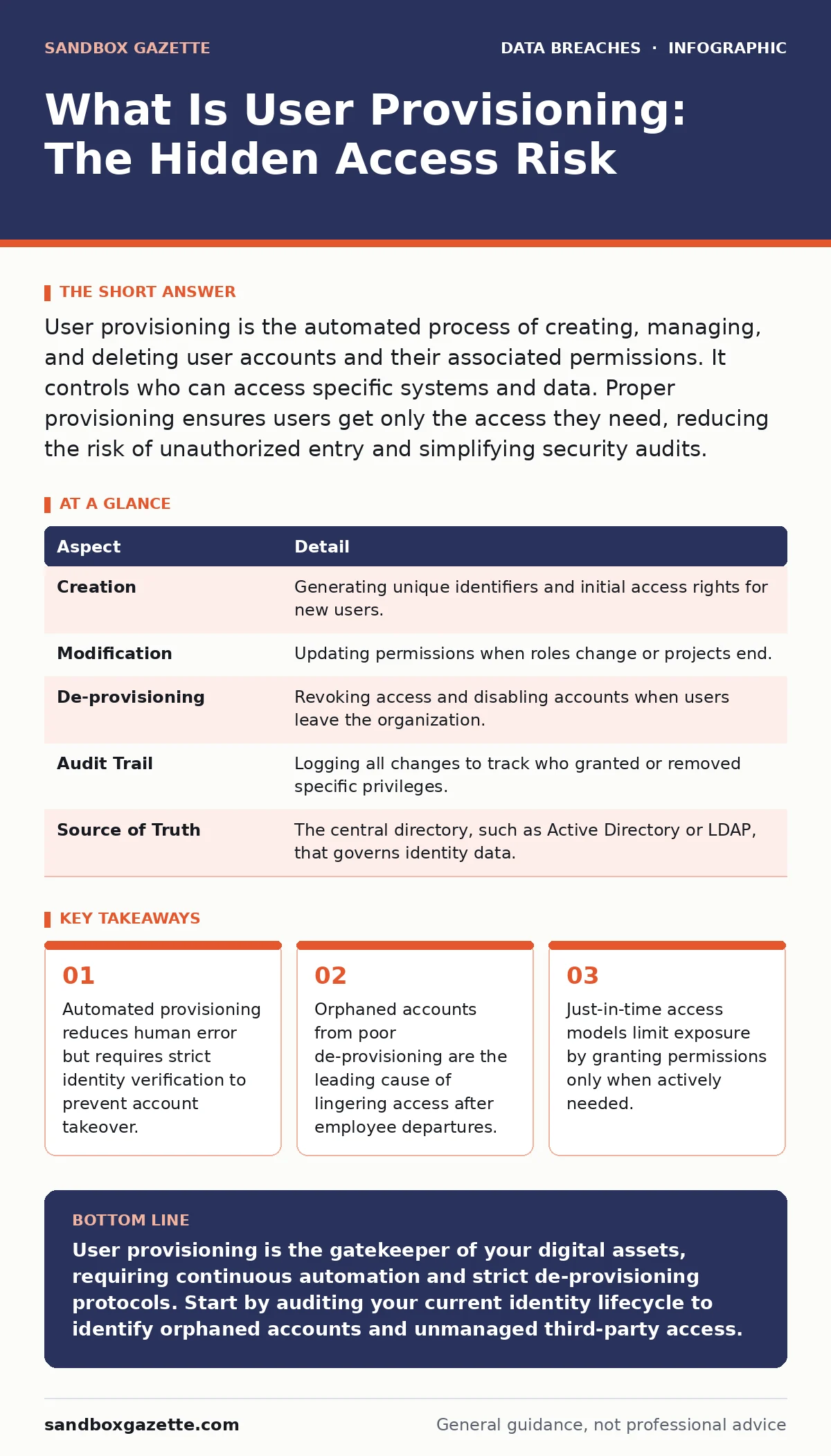
User provisioning is the automated process of creating, managing, and deleting user accounts and their associated permissions. It controls who can access specific systems and data. Proper provisioning ensures users get only the access they need, reducing the risk of unauthorized entry and simplifying security audits.
What Is User Provisioning
User provisioning is the administrative process of creating and managing digital identities within an organization's infrastructure. It determines which systems, applications, and data repositories a specific individual can access. This process is the foundation of identity and access management. Without precise provisioning, you cannot enforce the principle of least privilege, which dictates that users should only have the minimum access required to perform their job functions. The mechanism involves mapping human roles to technical permissions.
| Aspect | Detail |
|---|---|
| Creation | Generating unique identifiers and initial access rights for new users. |
| Modification | Updating permissions when roles change or projects end. |
| De-provisioning | Revoking access and disabling accounts when users leave the organization. |
| Audit Trail | Logging all changes to track who granted or removed specific privileges. |
| Source of Truth | The central directory, such as Active Directory or LDAP, that governs identity data. |
How Provisioning Works Mechanically
The system relies on a central identity provider that acts as the single source of truth for user attributes. When a new employee is added to this directory, automated scripts or identity governance platforms trigger actions across connected applications. These actions include creating email accounts, assigning software licenses, and granting file server permissions.
The process uses protocols like SCIM to standardize communication between the identity provider and service providers. This automation eliminates manual entry errors that often occur when administrators type credentials or select permissions by hand. Manual processes introduce latency and inconsistency, leading to privilege creep where users accumulate unnecessary permissions over time.
Who Is Affected By Access Errors
Every digital asset holder faces risks from flawed provisioning. Internal employees who change roles often retain access to previous departments, creating internal data leakage pathways. Contractors and temporary staff frequently receive permanent access levels that are never revoked after their engagement ends. External partners and vendors pose the highest risk when their access is not tightly scoped and time-bound.
Attackers target these groups because they often have weaker authentication requirements or less frequent monitoring. A single misconfigured provision can expose sensitive customer data or intellectual property to anyone with network access. The impact extends beyond data loss to include compliance violations and reputational damage.
Common Misconceptions About Access Control
Many organizations believe that once an account is created, the job is done. This static view ignores the dynamic nature of enterprise environments. Users move between teams, projects conclude, and software dependencies shift. Another common error is assuming that multi-factor authentication compensates for excessive permissions. Multi-factor authentication verifies identity but does not limit what that identity can do. If an attacker compromises a highly privileged account, strong authentication only delays the inevitable data exfiltration. You must treat permissions as perishable assets that require constant renewal and validation.
The Hidden Cost of Orphaned Accounts
Orphaned accounts are identities that remain active after the associated user has left the organization or changed roles. These accounts are the silent killers of security posture. They do not trigger alerts because they belong to valid users. They bypass behavioral analysis tools that expect legitimate activity patterns.
Attackers who gain access to an orphaned account can move laterally through the network with minimal resistance. The cost of remediation is high because identifying these accounts requires cross-referencing HR records with system logs, a process that is often manual and error-prone. Regular audits are necessary to detect and remove these dormant threats before they are exploited.
See also: Remote Desktop Abuse: The Configuration Mistakes That Hand Over Control · Access Controls for AI Agents: A Practical Implementation Checklist
Integrating With Third-Party Risk
Provisioning does not exist in a vacuum. External vendors often require access to internal systems to perform services. This creates a bridge between your security perimeter and their operational environment. If you do not include third-party access in your provisioning workflow, you create blind spots. These accounts may not adhere to your internal password policies or session timeout settings.
Refer to our guide on third-party risk assessments to understand how to evaluate the security posture of vendors before granting them any level of access. Ensuring that external identities are managed with the same rigor as internal ones prevents unauthorized data flows and reduces the attack surface.
Implementing Just-In-Time Access
Traditional provisioning grants permanent access based on role, which leads to privilege accumulation. Just-in-time provisioning grants access only when it is actively needed and revokes it immediately after the task is complete. This model reduces the window of opportunity for attackers. It requires a more sophisticated workflow where users request access for specific tasks, which is then approved and automatically expired. This approach aligns with the zero trust architecture, which assumes no user or device is trusted by default. It forces a continuous verification of intent and identity for every access request.
Automating The De-Provisioning Process
De-provisioning is the most critical phase of the lifecycle, yet it is often the most neglected. When an employee leaves, their access must be revoked instantly across all systems. Automation tools should listen for termination events in human resources systems and trigger immediate disabling of accounts. Delayed de-provisioning allows former employees to access data, potentially leading to insider data theft. It also leaves accounts open for attackers who may have already compromised the credentials. Ensure that your automation covers all connected applications, including legacy systems that may not have modern API integrations.
Maintaining Accurate Identity Records
The accuracy of your provisioning depends on the quality of your identity data. If the central directory contains incorrect role assignments, the automated provisioning will propagate those errors. Regular reconciliation processes must compare system permissions against authorized role definitions. This ensures that no user has privileges they are not entitled to. It also helps identify shadow IT applications that have been provisioned without central oversight. Refer to the guide on shadow IT data exposure to learn how to detect and manage unsanctioned applications that bypass standard provisioning controls. Clean data is the prerequisite for secure access.
Key takeaways
- Automated provisioning reduces human error but requires strict identity verification to prevent account takeover.
- Orphaned accounts from poor de-provisioning are the leading cause of lingering access after employee departures.
- Just-in-time access models limit exposure by granting permissions only when actively needed.
User provisioning is the gatekeeper of your digital assets, requiring continuous automation and strict de-provisioning protocols. Start by auditing your current identity lifecycle to identify orphaned accounts and unmanaged third-party access.
Frequently asked questions
How does user provisioning differ from user onboarding?
Onboarding is the human process of integrating a new employee, including training and equipment. Provisioning is the technical process of creating their digital identity and assigning system permissions.
Can automated provisioning be bypassed by attackers?
Attackers cannot bypass the mechanism itself, but they can exploit it by compromising the identity provider or manipulating the data sources that trigger provisioning actions.
What is the role of SCIM in provisioning?
SCIM is a standard protocol that allows different identity systems to communicate and exchange user information, enabling automated account creation and updates across diverse platforms.
How often should provisioning audits be performed?
Audits should be continuous or near-real-time using automated tools, with comprehensive manual reviews conducted quarterly to catch anomalies that automated rules might miss.
How this guide was produced: written by the Sandbox Gazette editorial team with AI assistance, checked against the public references listed below, and reviewed when the facts change. See our editorial policy or report an error.