
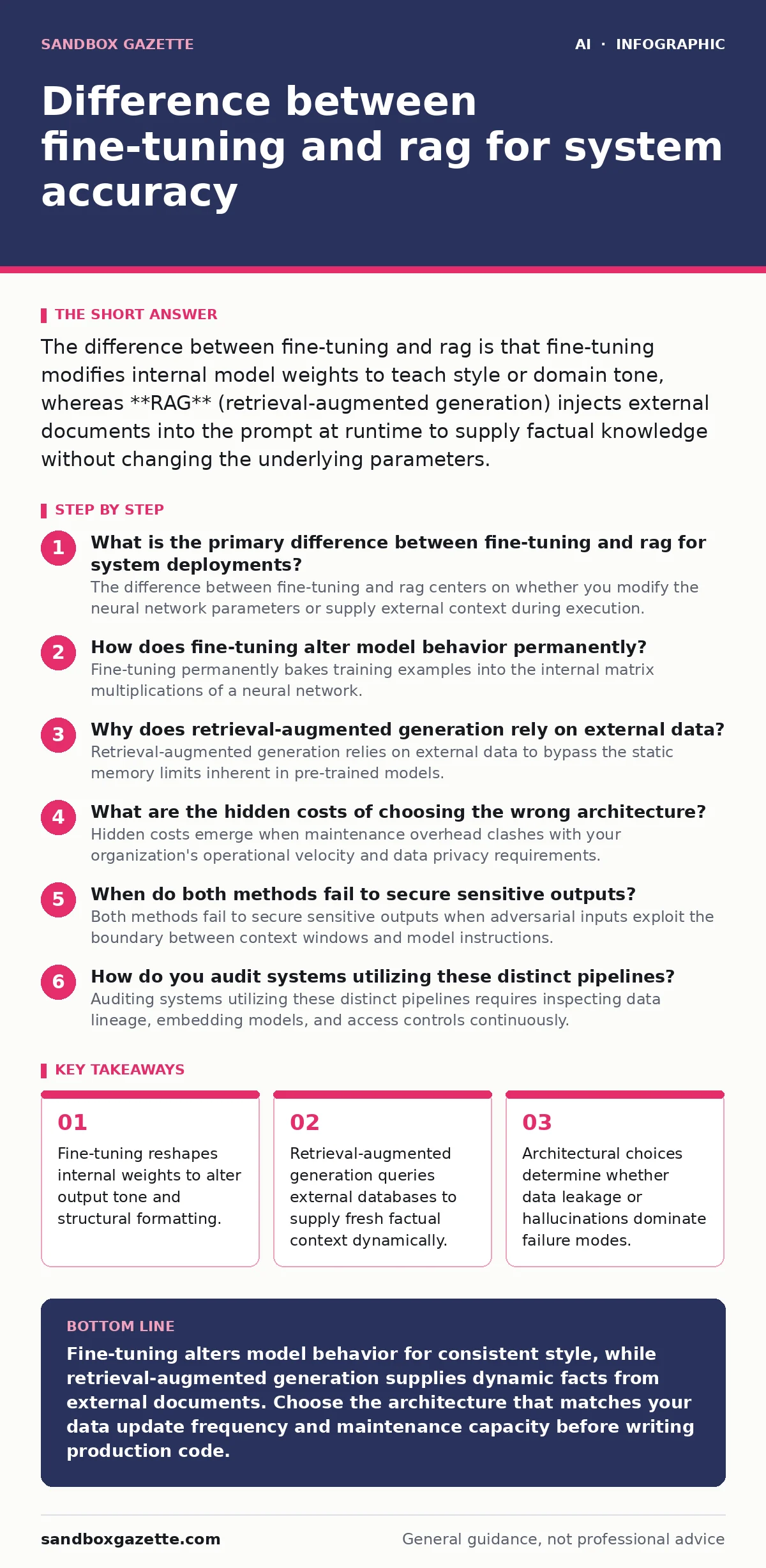
The difference between fine-tuning and rag is that fine-tuning modifies internal model weights to teach style or domain tone, whereas **RAG** (retrieval-augmented generation) injects external documents into the prompt at runtime to supply factual knowledge without changing the underlying parameters.
What is the primary difference between fine-tuning and rag for system deployments?
The difference between fine-tuning and rag centers on whether you modify the neural network parameters or supply external context during execution. Fine-tuning adjusts the internal weights of a model using a specialized dataset to teach specific conversational styles or proprietary syntaxes. Retrieval-augmented generation leaves the base model untouched, fetching relevant text chunks from an external database and appending them directly into your prompt window before generation occurs.
Choosing the wrong paradigm creates severe operational friction. If you need a model to adopt a strict medical vocabulary and output format, internal weight adjustment succeeds where external document lookup stutters. If you need a model to reference changing daily inventory logs, external lookup succeeds where internal weight adjustment suffers from static memory limitations and expensive retraining cycles.
How does fine-tuning alter model behavior permanently?
Fine-tuning permanently bakes training examples into the internal matrix multiplications of a neural network. This mechanism alters how the system responds to prompts by changing probability distributions across its entire vocabulary. You gain predictable style adherence and domain-specific formatting without needing massive context windows for every single query.
Weight adjustment comes with distinct operational hazards. Imagine training a model on a set of internal technical support tickets to improve troubleshooting speeds. The system absorbs the stylistic patterns of your support engineers, but it also memorizes incorrect troubleshooting steps or obsolete configurations present in those old tickets, baking those errors directly into its core behavior.
Why does retrieval-augmented generation rely on external data?
Retrieval-augmented generation relies on external data to bypass the static memory limits inherent in pre-trained models. This architecture intercepts incoming user queries, searches an external document store for matching semantic content, and inserts those retrieved passages directly into the prompt context. The underlying model reads the injected text and formulates an answer based strictly on the provided material rather than internal guesswork.
| Architecture | Primary Mechanism | Data Freshness | Failure Mode |
|---|---|---|---|
| Fine-tuning | Weight adjustment | Static until retrained | Memorized hallucinations |
| Retrieval-augmented generation | Prompt injection | Dynamic per query | Retrieval misses |
External document stores introduce complex synchronization challenges. If you update a policy document in your storage repository, the search index must re-index that document immediately. Otherwise, the retrieval engine pulls stale information, causing the model to generate confident answers based on outdated protocols.
What are the hidden costs of choosing the wrong architecture?
Hidden costs emerge when maintenance overhead clashes with your organization's operational velocity and data privacy requirements. Fine-tuning demands continuous curation of training datasets, rigorous validation checks, and expensive compute resources every time underlying facts change. Retrieval-augmented generation demands constant maintenance of vector databases, chunking strategies, and embedding models to ensure relevant passages actually surface during a query.
Organizations attempting to implement these systems often overlook the engineering burden of data hygiene. Clean data ingestion pipelines are mandatory for both approaches, but poor input quality manifests differently. Bad training data corrupts model behavior uniformly, while bad retrieval data causes erratic omissions where the model ignores critical context entirely.
When do both methods fail to secure sensitive outputs?
Both methods fail to secure sensitive outputs when adversarial inputs exploit the boundary between context windows and model instructions. Integrating these pipelines requires rigorous evaluation strategies similar to those found in AI risk management frameworks. An attacker can craft prompts that trick a fine-tuned model into ignoring its safety training or manipulate a retrieval pipeline into pulling malicious external documents that override system instructions.
Mitigating these vulnerabilities requires defensive guardrails that inspect both the incoming query and the retrieved context before it reaches the generation layer. Relying solely on the model to police its own inputs invites prompt injection attacks that bypass semantic filters. You must treat every retrieved document as untrusted user input, regardless of where it originates inside your internal storage ecosystem.
How do you audit systems utilizing these distinct pipelines?
Auditing systems utilizing these distinct pipelines requires inspecting data lineage, embedding models, and access controls continuously. For retrieval architectures, you must verify that the search mechanism respects user permissions before fetching documents. This mirrors the granular restrictions necessary for access controls for AI agents operating within enterprise networks.
Tracing errors in adjusted models proves significantly more difficult than debugging retrieval pipelines. When an external lookup fails, you can inspect the exact document chunk that caused the hallucination. When a fine-tuned model outputs incorrect information, untangling which training epoch or specific example caused the behavioral drift requires exhaustive dataset versioning and activation analysis.
What are the scaling limits of combining both techniques?
Combining both techniques scales operational complexity exponentially rather than solving all accuracy problems simultaneously. Many engineering teams attempt to fine-tune a model on domain terminology while simultaneously using external lookups for factual retrieval. This hybrid approach demands robust monitoring infrastructure to detect when internal biases conflict with freshly retrieved external facts.
Such complex deployments require specialized oversight to catch silent failures before they impact downstream applications. This level of telemetry aligns with the practices recommended in AI-assisted threat detection protocols, where automated monitors watch for unusual behavioral deviations. Balancing compute budgets against accuracy gains remains the defining challenge of modern machine learning architecture decisions.
Key takeaways
- Fine-tuning reshapes internal weights to alter output tone and structural formatting.
- Retrieval-augmented generation queries external databases to supply fresh factual context dynamically.
- Architectural choices determine whether data leakage or hallucinations dominate failure modes.
Fine-tuning alters model behavior for consistent style, while retrieval-augmented generation supplies dynamic facts from external documents. Choose the architecture that matches your data update frequency and maintenance capacity before writing production code.
Frequently asked questions
Can I use retrieval-augmented generation to completely replace fine-tuning?
You cannot replace fine-tuning entirely with retrieval because external documents cannot teach a model specialized formatting or complex behavioral rules that require structural adaptation.
Why does a fine-tuned model hallucinate more facts than a retrieval system?
Fine-tuned models hallucinate because they interpolate answers from compressed statistical weights rather than citing specific external source documents during generation.
How often must I retrain a fine-tuned model compared to updating a retrieval database?
You must retrain a fine-tuned model whenever core behavioral patterns or terminology change, whereas a retrieval database requires continuous updates as new documents arrive.
Does retrieval-augmented generation protect data privacy better than fine-tuning?
Retrieval-augmented generation keeps sensitive data out of model weights, but it creates new privacy risks if the search index fails to enforce strict access controls on fetched documents.
How this guide was produced: written by the Sandbox Gazette editorial team with AI assistance, checked against the public references listed below, and reviewed when the facts change. See our editorial policy or report an error.