
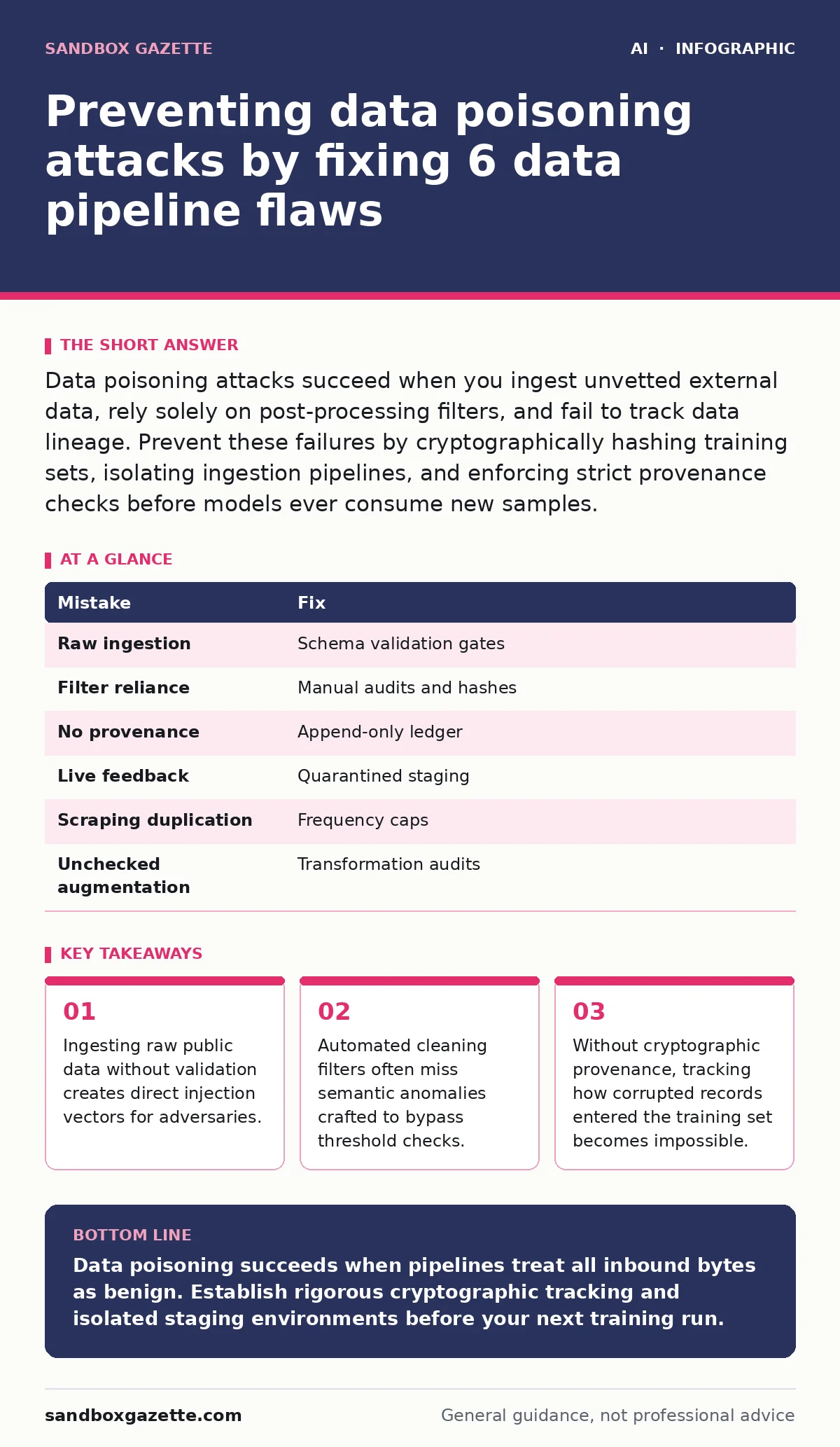
Data poisoning attacks succeed when you ingest unvetted external data, rely solely on post-processing filters, and fail to track data lineage. Prevent these failures by cryptographically hashing training sets, isolating ingestion pipelines, and enforcing strict provenance checks before models ever consume new samples.
Mistake 1: Ingesting raw external datasets without structural validation
Why it hurts: Ingesting external data directly into your machine learning pipeline allows threat actors to inject malicious samples disguised as normal training records. When neural networks process these unvetted inputs, the optimization algorithm updates model weights to accommodate the poisoned patterns. This results in backdoors where the system functions normally on standard inputs but outputs attacker-controlled classifications on specific triggers.
The fix: Implement strict schema validation and anomaly detection gates at the ingestion boundary. Drop any record that deviates from expected data types, range bounds, or token distributions before it touches storage used for model training.
Mistake 2: Relying solely on automated cleaning filters for outlier removal
Why it hurts: Automated cleaning filters designed to remove statistical outliers often fail against sophisticated poisoning attacks that keep malicious samples within normal variance bounds. Adversaries craft poisoned inputs to sit just inside the decision boundary, ensuring the cleaning script perceives them as legitimate edge cases. These subtle corruptions accumulate over successive training runs, gradually degrading model accuracy or steering behavior toward targeted misclassifications.
The fix: Combine automated statistical filters with manual audits of high-impact training partitions and cryptographic integrity checks. Human review catches semantic inconsistencies that automated algorithms miss.
Mistake 3: Failing to maintain cryptographic provenance for training records
Why it hurts: Failing to track cryptographic provenance means you cannot identify which batch introduced corrupted records once a model exhibits malicious behavior. Without immutable records of ingestion dates, source identifiers, and transformation histories, forensic investigation stalls out in ambiguity. You are left guessing whether the degradation stems from natural distribution drift or targeted data tampering.
The fix: Generate cryptographic hashes for every data batch at the moment of collection and store those hashes in an append-only ledger. This ledger provides a verifiable audit trail for every sample utilized during training.
Mistake 4: Mixing continuous learning pipelines with real-time user inputs
Why it hurts: Mixing continuous learning pipelines with real-time user inputs gives adversaries a direct feedback loop to manipulate model behavior on the fly. If the system automatically retrains on incoming user feedback or scraped interactions, an attacker can repeatedly submit crafted inputs to poison the next generation of weights. This dynamic exploitation turns your own operational interface into an active vector for persistent model subversion.
The fix: Decouple operational inference from model training by interposing a quarantined staging environment. All data collected during live operation must undergo offline verification and approval before joining the authoritative training corpus.
Mistake 5: Neglecting data duplication limits across distributed scraping jobs
Why it hurts: Neglecting data duplication limits across distributed scraping jobs allows attackers to amplify the influence of poisoned samples through sheer repetition. If an adversary floods public forums with duplicate copies of a malicious data point, distributed scrapers ingest every instance, artificially inflating the weight of that specific corruption during gradient descent. The model treats frequency as importance, amplifying the impact of minority injections.
The fix: Enforce strict deduplication and deduplication frequency caps during the collection phase. Normalizing sample frequency ensures that no single source dominates the statistical distribution of the training set.
See also: What Does AI Bias Mean: How Training Data Distorts Model Decisions · How Machine Learning Detects Cyber Threats: A Technical Breakdown
Mist> WARNING: Automated scraping without frequency caps turns low-effort noise into dominant training signals.
Mistake 6: Treating data augmentation scripts as immune to injection
Why it hurts: Treating data augmentation scripts as immune to injection creates hidden vulnerabilities when automated transformations magnify subtle poisons. If an augmentation pipeline introduces noise, rotations, or synthetic variations to a mildly corrupted base record, the resulting output can become a potent trigger for model failure. The augmentation process inadvertently weaponizes borderline anomalies that would otherwise remain inert.
The fix: Audit augmentation codebases regularly and apply validation checks to synthetically generated samples. Ensure transformation logic cannot amplify input anomalies beyond acceptable safety thresholds.
| Mistake | Fix |
|---|---|
| Raw ingestion | Schema validation gates |
| Filter reliance | Manual audits and hashes |
| No provenance | Append-only ledger |
| Live feedback | Quarantined staging |
| Scraping duplication | Frequency caps |
| Unchecked augmentation | Transformation audits |
Key takeaways
- Ingesting raw public data without validation creates direct injection vectors for adversaries.
- Automated cleaning filters often miss semantic anomalies crafted to bypass threshold checks.
- Without cryptographic provenance, tracking how corrupted records entered the training set becomes impossible.
Data poisoning succeeds when pipelines treat all inbound bytes as benign. Establish rigorous cryptographic tracking and isolated staging environments before your next training run.
Frequently asked questions
How do data poisoning attacks differ from traditional software exploits?
Traditional exploits target code execution flaws, whereas data poisoning manipulates the statistical weights of a machine learning model by corrupting its training diet.
Can pre-trained foundation models suffer from data poisoning?
Foundation models are highly vulnerable during their initial pre-training phase and subsequent fine-tuning stages if the ingested text or imagery contains maliciously crafted patterns.
What role does data diversity play in mitigating poisoning?
High diversity dilutes the impact of isolated poisoned samples, but targeted attacks still succeed if the volume of malicious input overcomes the signal-to-noise ratio.
How this guide was produced: written by the Sandbox Gazette editorial team with AI assistance, checked against the public references listed below, and reviewed when the facts change. See our editorial policy or report an error.