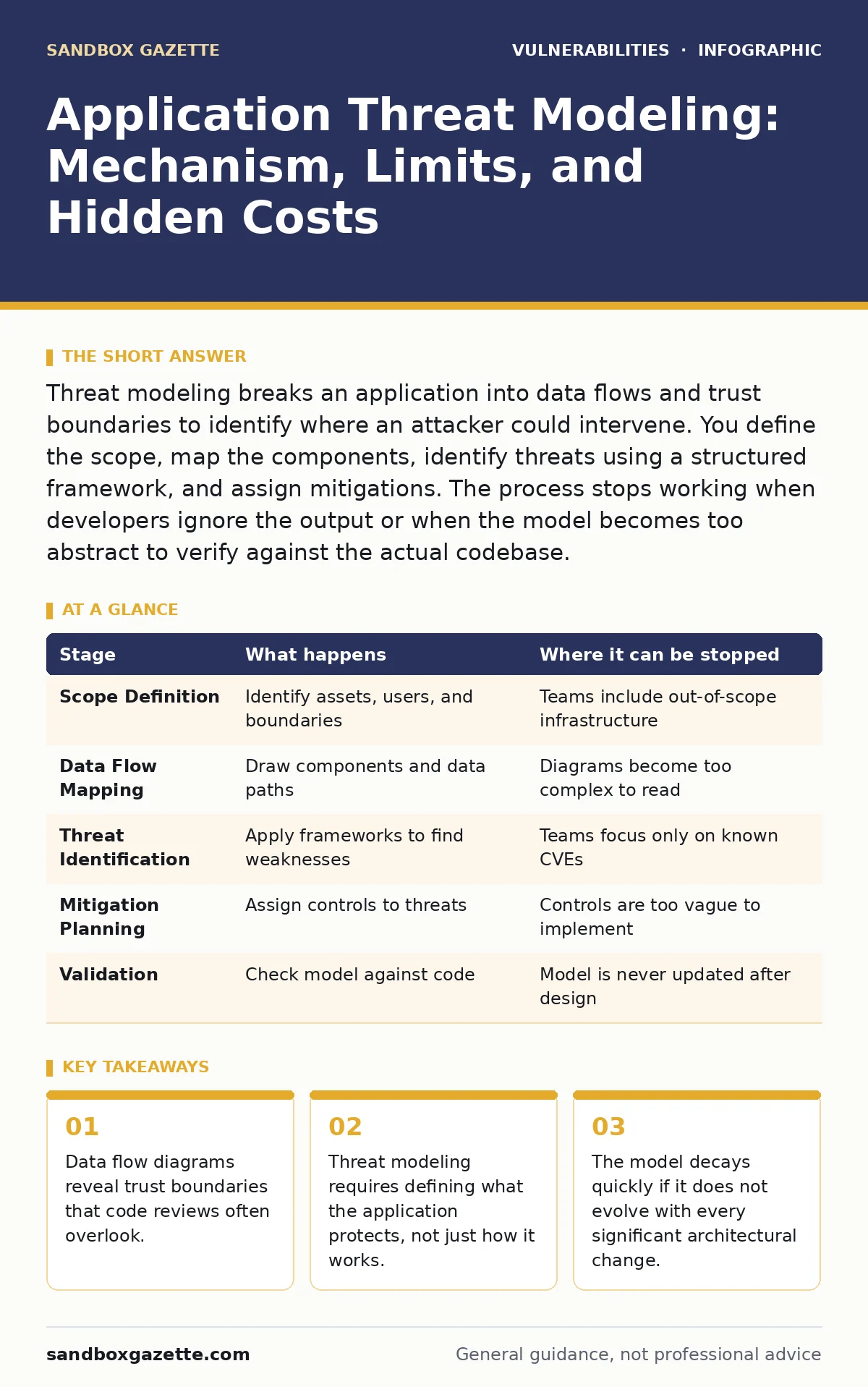
Threat modeling breaks an application into data flows and trust boundaries to identify where an attacker could intervene. You define the scope, map the components, identify threats using a structured framework, and assign mitigations. The process stops working when developers ignore the output or when the model becomes too abstract to verify against the actual codebase.
Defining the Scope and Assets
Threat modeling begins by identifying what needs protection. You must define the application’s boundaries and the data it handles. This step determines which assets are in scope and which are external. A common mistake is including too much infrastructure. You focus on the application logic and the data it processes. External services are treated as untrusted inputs unless you control them.
You identify the critical data elements first. Personal identifiers, authentication tokens, and financial records require different protections than public content. You also define the users. Administrators have different privileges than standard users. You map these roles to their expected actions. This creates a baseline for normal behavior. Deviations from this baseline become suspicious.
Mapping the Data Flow
You create a data flow diagram to visualize how information moves. This diagram shows components, data stores, and the paths between them. You mark every entry point where data enters the system. You also mark every exit point where data leaves. Trust boundaries are the critical elements here. A trust boundary is a line between components with different security contexts.
Data crosses these boundaries frequently. When data moves from an untrusted client to a trusted server, the boundary is crossed. When data moves from a trusted database to an untrusted API, the boundary is crossed. You must label each boundary clearly. You also label the data in transit. Is it encrypted? Is it authenticated? The diagram must show these properties.
| Stage | What happens | Where it can be stopped |
|---|---|---|
| Scope Definition | Identify assets, users, and boundaries | Teams include out-of-scope infrastructure |
| Data Flow Mapping | Draw components and data paths | Diagrams become too complex to read |
| Threat Identification | Apply frameworks to find weaknesses | Teams focus only on known CVEs |
| Mitigation Planning | Assign controls to threats | Controls are too vague to implement |
| Validation | Check model against code | Model is never updated after design |
Identifying Threats
You use a structured framework to find threats. STRIDE is a common choice. It stands for Spoofing, Tampering, Repudiation, Information Disclosure, Denial of Service, and Elevation of Privilege. You apply each category to every component and data flow. You ask specific questions. Can an attacker spoof the identity of a user? Can they tamper with data in transit?
This step requires imagination. You assume the attacker knows the system. You assume they want to break the rules. You do not assume they are clever. You assume they are persistent. You look for logic errors. Logic errors are flaws in the business rules. They are not bugs in the code syntax. They are mistakes in how the application handles decisions.
Assessing Impact and Likelihood
You evaluate each threat based on impact and likelihood. Impact is the damage caused if the threat materializes. Likelihood is the probability of the attack succeeding. You do not use numbers. You use relative scales. High, medium, and low are sufficient. This helps you prioritize. You cannot fix everything. You fix the high-impact, high-likelihood threats first.
Context matters. A data leak in a public blog has low impact. The same leak in a healthcare app has high impact. You consider the environment. Is the application internal or external? Is it behind a firewall or exposed to the internet? These factors change the likelihood. You also consider the attacker’s motivation. Would an attacker spend time breaking this feature?
Planning Mitigations
You assign controls to each threat. Controls can be technical or procedural. Technical controls include encryption, input validation, and access lists. Procedural controls include code reviews and monitoring. You define the control clearly. Vague controls fail. "Use encryption" is vague. "Encrypt data in transit using TLS 1.2 or higher" is specific.
You consider the cost of the control. Some controls add latency. Some controls reduce usability. You balance security with functionality. You also consider defense in depth. You do not rely on a single control. You layer controls. If one fails, another catches the threat. This reduces the risk of a single point of failure.
See also: Can Password Managers Be Hacked? Risks and Mitigation · How MITRE ATLAS Prevents AI Model Supply Chain Failures
Validating and Maintaining
You verify the model against the implementation. You check if the controls are actually in place. You review the code. You test the endpoints. If the code does not match the model, you update the model. You do not ignore the discrepancy. This step closes the loop. It ensures the theory matches reality.
You schedule regular reviews. You review the model when new features are added. You review it when new threats emerge. You review it when the architecture changes. This keeps the model relevant. It also helps new team members understand the security posture. The model becomes a living document.
Integrating with Development
Threat modeling works best when integrated into the development process. You perform it during the design phase. You catch issues before code is written. This is cheaper than fixing them later. You also perform it during code reviews. You check if the implementation matches the model. This prevents drift.
You share the model with the team. You discuss the threats and controls. This builds security awareness. It also encourages ownership. Developers are more likely to fix issues they helped identify. You also use the model for bug bounty triage. It helps you understand which reports are critical. It provides context for the findings.
Limits of the Process
Threat modeling has limits. It cannot find every bug. It misses implementation errors. It misses configuration mistakes. It relies on the accuracy of the model. If the model is wrong, the analysis is wrong. You must validate it. You also need skilled people. Poor modeling leads to false confidence.
The process is slow. It takes time to map and analyze. Teams often skip it under pressure. This is a risk. You must allocate time for it. You also face resistance. Developers may see it as bureaucracy. You must show the value. You demonstrate how it prevents costly fixes. You also link it to patch management. Understanding the threat helps you prioritize patches.
You also consider vulnerability chaining. A single weak control may not be exploitable. But chained with another weakness, it becomes critical. Threat modeling helps you see these chains. It shows how threats combine. This is why you map the whole flow. You look for the path of least resistance.
Handling Specific Vulnerabilities
Some vulnerabilities are hard to model. Memory corruption vulnerabilities require deep code analysis. They are not always visible in high-level diagrams. You need to combine modeling with static analysis. Heap overflow vulnerabilities are similar. They depend on memory layout. You must understand the runtime environment.
Path traversal vulnerabilities and open redirect vulnerabilities are logic errors. They are easier to model. You look for user input in file paths or URLs. You check if the input is validated. You also check HTTP security headers. They provide defense in depth. You model them as controls. You verify they are set correctly.
Key takeaways
- Data flow diagrams reveal trust boundaries that code reviews often overlook.
- Threat modeling requires defining what the application protects, not just how it works.
- The model decays quickly if it does not evolve with every significant architectural change.
Frequently asked questions
How often should you update a threat model?
Update the model whenever the architecture changes significantly. You should also review it quarterly to catch drift. Minor code changes may not require an update.
Can automated tools replace threat modeling?
No. Automated tools find known patterns. They miss logic errors and architectural flaws. Threat modeling provides the context that tools lack. You need both approaches.
Who should perform threat modeling?
The development team should perform it. Security teams should facilitate and review. Shared ownership ensures the model is practical. It also builds security skills in the team.
What if the team resists threat modeling?
Start small. Model one critical feature. Show the value by finding a real issue. Use the results to build trust. Integrate it into existing workflows. Do not add extra meetings.
How this guide was produced: written by the Sandbox Gazette editorial team with AI assistance, checked against the public references listed below, and reviewed when the facts change. See our editorial policy or report an error.