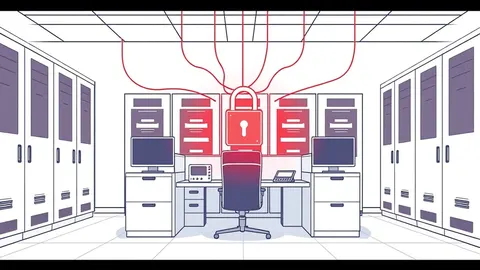
Secrets management is the practice of storing, rotating, and controlling access to sensitive credentials like API keys and passwords. It replaces static strings in code with dynamic tokens that expire quickly, reducing the window of opportunity for attackers who compromise your repository or application servers.
The Wallet Analogy for Digital Credentials
Imagine you carry your physical wallet everywhere. You hand it to the cashier to pay for coffee, then take it back. You do not leave your wallet on the counter while you walk away to find your car keys. Secrets management works the same way for your software. Your applications need credentials to connect to databases or cloud services. Instead of hardcoding those credentials into the application like a wallet left on a counter, the system retrieves them only when needed and discards them immediately after use.
This approach prevents the credential from existing in memory longer than necessary. It also ensures that the credential changes frequently, so a stolen token becomes useless within minutes or hours.
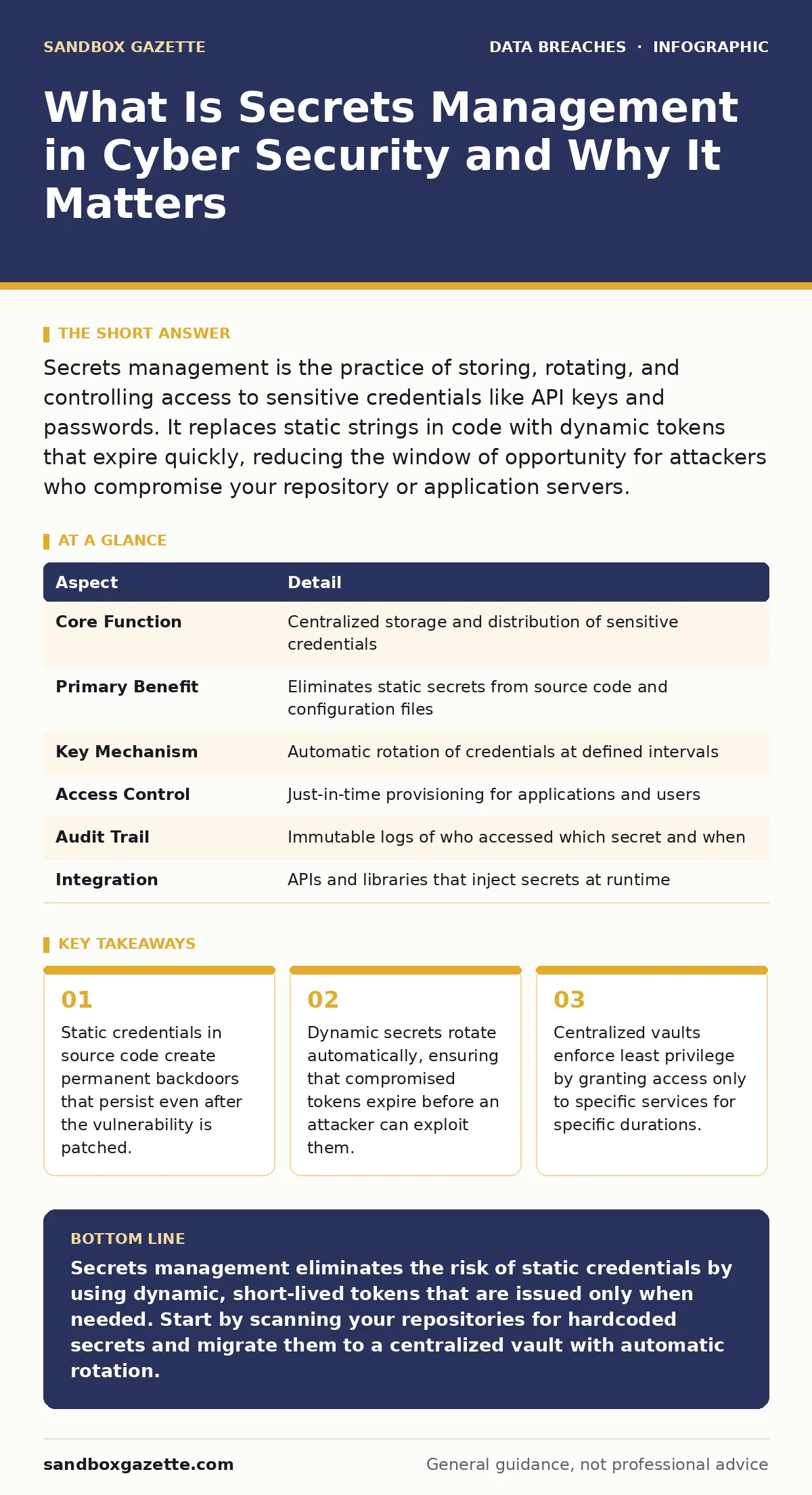
| Aspect | Detail |
|---|---|
| Core Function | Centralized storage and distribution of sensitive credentials |
| Primary Benefit | Eliminates static secrets from source code and configuration files |
| Key Mechanism | Automatic rotation of credentials at defined intervals |
| Access Control | Just-in-time provisioning for applications and users |
| Audit Trail | Immutable logs of who accessed which secret and when |
| Integration | APIs and libraries that inject secrets at runtime |
What Is Secrets Management in Cyber Security
Secrets management in cyber security is the systematic handling of sensitive data that grants access to systems, services, or data. This includes passwords, API keys, private keys, and tokens. Unlike user passwords, these secrets are often machine-to-machine credentials that run automated processes. If a human forgets a password, they reset it. If a machine forgets its API key, the service breaks. Therefore, these secrets must be stored securely and rotated automatically without human intervention.
The goal is to remove these values from version control systems, configuration files, and environment variables where they can be accidentally committed or exposed. By centralizing these assets, you gain visibility into where each credential is used and who has access to it. This visibility is the foundation of security hygiene for any modern infrastructure.
How Dynamic Rotation Works
Static secrets are the biggest risk in modern applications. When a developer hardcodes a database password into a script, that password remains valid until someone manually changes it. If that script is pushed to a public repository, the password is exposed forever. Dynamic secrets solve this by generating a new credential each time an application needs it.
The application requests a temporary token from a central vault. The vault issues a token with a short lifespan, such as one hour. When the application needs to connect again, it requests a new token. The old token expires and becomes invalid. This process happens automatically in the background. You do not need to schedule maintenance windows to rotate passwords. The system handles the lifecycle entirely.
Who Gets Left Behind
Secrets management affects every team that builds or operates software. Developers need to change how they write code to avoid embedding credentials. Operations teams need to configure the vault and integrate it with deployment pipelines. Security teams need to audit the usage patterns and enforce policies.
However, the impact is not evenly distributed. Small teams often skip formal secrets management because they view it as overhead. They rely on shared documents or chat messages to share keys. This creates a hidden risk profile. When a team member leaves, the keys they shared remain active. The new owner does not know which keys exist. This lack of inventory makes incident response nearly impossible. You cannot revoke what you cannot find.
The Hidden Cost of Convenience
Many organizations assume that using environment variables is sufficient for security. Environment variables hide the secret from the source code, but they are still visible to anyone with access to the running container or server. They are static. They do not rotate. They are often logged by application frameworks.
The hidden cost of this convenience is the accumulation of technical debt. Every static secret is a potential backdoor. When a breach occurs, investigators must determine which secrets were exposed. If you have thousands of static keys scattered across dozens of services, you cannot know which ones are compromised. You must rotate all of them, causing widespread outages. Dynamic rotation limits the blast radius to the specific service that was compromised.
See also: What Is User Provisioning: The Hidden Access Risk · Backup vs Archive: The Critical Difference for Data Resilience
What People Usually Get Wrong
A common mistake is treating the secrets vault as a magic bullet. The vault secures the storage, but it does not secure the usage. If an application logs the secret to a console or a file, the vault cannot prevent that exposure. You must configure your applications to mask sensitive data in logs.
Another error is over-permissioning. Teams often grant the vault access to all secrets for convenience. This violates the principle of least privilege. Each service should only have access to the specific secrets it needs. If a service is compromised, the attacker can only access those specific secrets. This containment strategy limits the damage.
Finally, organizations often ignore the audit logs. The vault records every access event. Reviewing these logs reveals anomalous behavior, such as a service accessing a secret it never used before. This early detection can stop an attack before data is exfiltrated.
Integrating with Existing Practices
Secrets management does not exist in a vacuum. It intersects with other security practices. For instance, user access provisioning must align with secret lifecycle management. When a user is offboarded, their access to the vault must be revoked immediately. This prevents former employees from accessing historical secrets.
Similarly, third-party risk assessments should include an evaluation of how vendors manage their own secrets. If a vendor uses static keys for your integration, your security posture is weakened. You cannot control their secrets, but you can require them to use dynamic tokens or short-lived credentials.
Building a Resilient Foundation
Implementing secrets management requires a shift in culture. Developers must learn to request secrets at runtime rather than embedding them at build time. This requires changes to CI/CD pipelines. The pipeline must inject secrets into the deployment environment securely.
You must also define clear policies for rotation frequency and access duration. Shorter lifespans increase security but may impact performance if the application cannot handle frequent re-authentication. Find the balance that fits your operational needs. Regularly test your incident response plans by simulating a secret leak. Verify that you can revoke the compromised secret and rotate it without taking down the entire service.
Key takeaways
- Static credentials in source code create permanent backdoors that persist even after the vulnerability is patched.
- Dynamic secrets rotate automatically, ensuring that compromised tokens expire before an attacker can exploit them.
- Centralized vaults enforce least privilege by granting access only to specific services for specific durations.
Secrets management eliminates the risk of static credentials by using dynamic, short-lived tokens that are issued only when needed. Start by scanning your repositories for hardcoded secrets and migrate them to a centralized vault with automatic rotation.
Frequently asked questions
Do I need secrets management for small projects?
Yes, because small projects are often the entry point for attackers. Hardcoded secrets in small projects are easy to find and exploit, leading to lateral movement in larger systems.
How do I handle secrets in serverless functions?
Serverless functions should request temporary credentials from the identity provider at runtime. Avoid embedding keys in the function code or environment variables.
Can secrets management prevent all data breaches?
No, it only protects credential exposure. It does not prevent application vulnerabilities, social engineering, or physical theft of devices.
What is the difference between a password manager and a secrets manager?
Password managers are for human users and store static passwords. Secrets managers are for machines and provide dynamic, rotating credentials with programmatic access.
How this guide was produced: written by the Sandbox Gazette editorial team with AI assistance, checked against the public references listed below, and reviewed when the facts change. See our editorial policy or report an error.