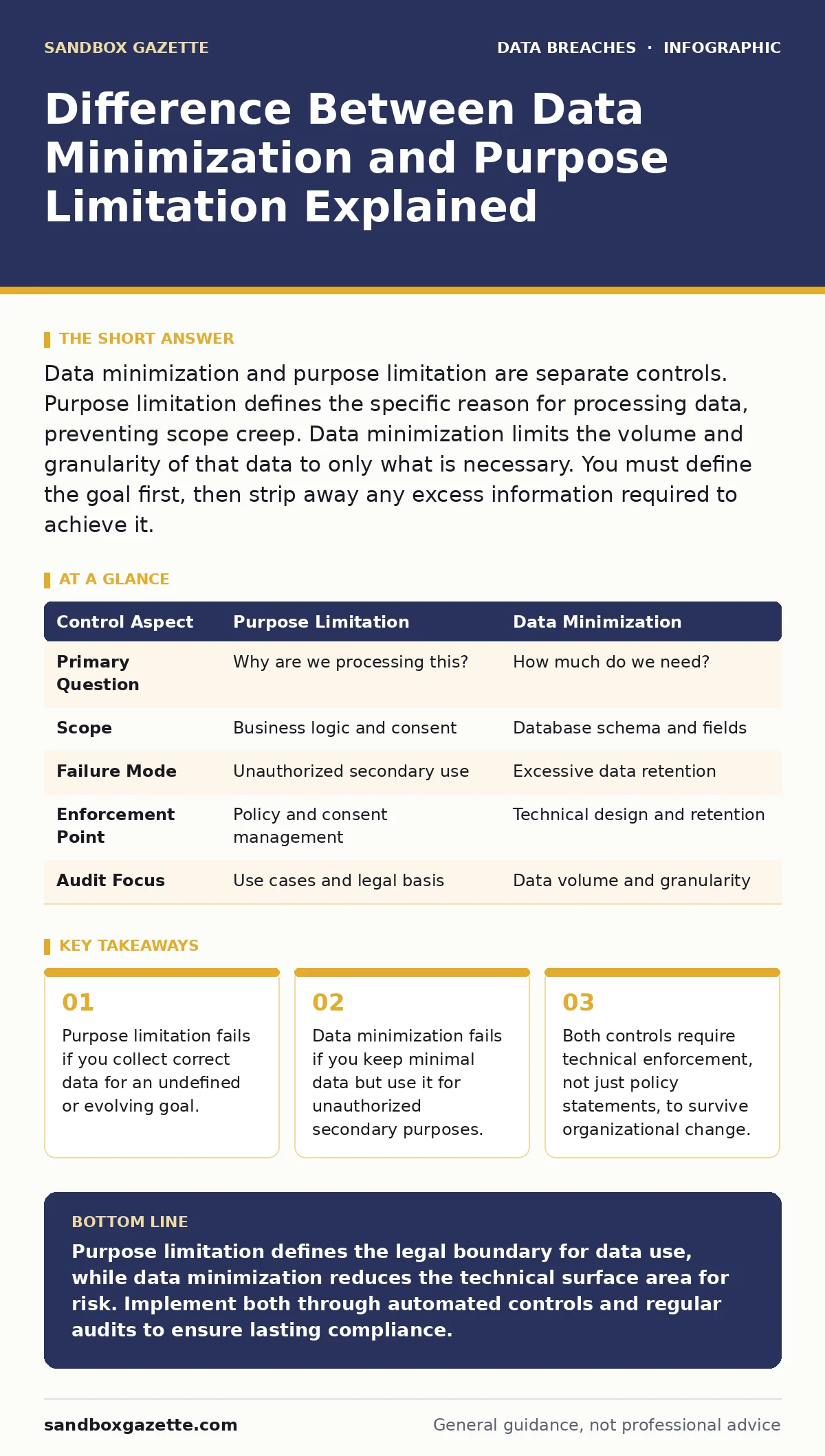
Data minimization and purpose limitation are separate controls. Purpose limitation defines the specific reason for processing data, preventing scope creep. Data minimization limits the volume and granularity of that data to only what is necessary. You must define the goal first, then strip away any excess information required to achieve it.
What is the difference between data minimization and purpose limitation?
Purpose limitation restricts the reasons you process personal data, while data minimization restricts the quantity and type of data you retain. Purpose limitation asks why you need the data at all. Data minimization asks if you need every field in that dataset. These two principles work together but address different risks. Purpose limitation prevents mission creep, where data collected for one task is repurposed for another without consent. Data minimization reduces the blast radius of a breach by ensuring less sensitive information is available to attackers.
How do you define purpose limitation in practice?
Purpose limitation requires a specific, explicit, and legitimate reason for every data processing activity. You cannot collect data "just in case" it might be useful later. The purpose must be defined before collection begins. If you change the purpose, you must obtain new consent or a new legal basis. This prevents organizations from using customer support logs for marketing campaigns without permission. It also stops internal teams from mining employee productivity data for performance reviews when the system was designed only for payroll.
What does data minimization actually require?
Data minimization demands that you collect only data adequate, relevant, and limited to what is necessary for the stated purpose. If you only need a phone number to contact a user, you should not collect their home address. If you need an address for shipping, you should not collect their date of birth unless legally required. This principle forces engineers to design systems that drop unnecessary fields at the ingress point. It also requires regular audits to remove data that has outlived its usefulness.
Why do these concepts get confused?
Teams confuse these concepts because they often appear in the same compliance checklist. Both aim to reduce privacy risk, but they operate at different stages of the data lifecycle. Purpose limitation is a strategic constraint on business logic. Data minimization is a tactical constraint on database schema and application design. Treating them as identical leads to gaps. You might minimize data perfectly but still violate purpose limitation by using that minimal data for an unauthorized secondary analysis.
What happens when purpose limitation fails?
When purpose limitation fails, you face regulatory penalties and loss of user trust. Repurposing data without a new legal basis is a direct violation of privacy laws. Imagine an organization collecting health metrics for fitness tracking but selling that data to insurance providers. The data might be minimal, but the purpose has changed. This creates liability regardless of how secure the storage is. It also exposes you to reputational damage that technical controls cannot fix.
See also: Endpoint Telemetry FAQs: What Agents Actually See · Email Encryption Best Practices for Secure Data Exchange
What are the consequences of ignoring data minimization?
Ignoring data minimization increases the impact of every security incident. If you store excessive data, a breach exposes more sensitive information than necessary. This magnifies the harm to individuals and the legal exposure for the organization. It also complicates data subject access requests, as you must locate and delete more records. Excess data clutters your environment, making it harder to detect anomalies. It also increases storage costs and backup times without adding business value.
| Control Aspect | Purpose Limitation | Data Minimization |
|---|---|---|
| Primary Question | Why are we processing this? | How much do we need? |
| Scope | Business logic and consent | Database schema and fields |
| Failure Mode | Unauthorized secondary use | Excessive data retention |
| Enforcement Point | Policy and consent management | Technical design and retention |
| Audit Focus | Use cases and legal basis | Data volume and granularity |
How do you implement both controls technically?
Implementation requires embedding these principles into your software development lifecycle. Start by mapping data flows and defining the purpose for each flow. Then, design your database schemas to exclude any field not strictly required for that purpose. Use automated tools to enforce field-level restrictions. Implement retention policies that delete data automatically when the purpose is fulfilled. Regularly review access logs to ensure no one is using data for unapproved purposes. This technical approach is more reliable than relying on employee vigilance.
What exceptions exist for these principles?
Exceptions are narrow and must be legally justified. You may retain data longer than necessary for legal compliance, such as tax records. You may process data for public interest or historical research, provided appropriate safeguards are in place. Public health emergencies may allow broader data use, but this is temporary. These exceptions do not give you free rein to collect everything. You must still minimize data within the exception's scope. Document every exception clearly to prove it is necessary and proportionate.
How do you handle third-party data risks?
Third-party vendors often fail to adhere to your minimization and limitation standards. They may collect more data than you share, or use your data for their own purposes. You must include strict clauses in contracts that mirror your internal controls. Require vendors to delete data after service completion. Conduct regular audits to verify their compliance. This aligns with best practices for third-party risk assessments, ensuring your supply chain does not become your weakest link. If a vendor breaches these terms, you remain liable for the misuse of your users' data.
What is the long-term maintenance burden?
Maintaining these controls requires continuous effort. Business needs change, and so do legal requirements. You must update your data maps and retention policies regularly. New features often introduce new data collection points that bypass existing controls. Conduct periodic reviews to identify shadow IT data exposure, where teams create unauthorized data stores. Train developers to view privacy as a design constraint, not an afterthought. This ongoing discipline prevents drift and ensures compliance remains effective over time.
Key takeaways
- Purpose limitation fails if you collect correct data for an undefined or evolving goal.
- Data minimization fails if you keep minimal data but use it for unauthorized secondary purposes.
- Both controls require technical enforcement, not just policy statements, to survive organizational change.
Purpose limitation defines the legal boundary for data use, while data minimization reduces the technical surface area for risk. Implement both through automated controls and regular audits to ensure lasting compliance.
Frequently asked questions
Can I collect extra data for future AI training?
No, collecting data for unspecified future purposes violates purpose limitation. You must define the AI training purpose upfront and obtain specific consent.
Does anonymization satisfy data minimization?
Anonymization reduces risk but does not replace minimization. You should still collect only what is necessary before anonymizing, as re-identification risks exist.
How do I handle user requests to delete data?
Implement automated deletion workflows triggered by retention dates or user requests. Ensure backups are also purged within a reasonable timeframe.
What if a regulator demands more data than we collect?
You cannot retroactively collect data you did not gather. Explain your minimization controls and provide the available data that meets the legal request.
How this guide was produced: written by the Sandbox Gazette editorial team with AI assistance, checked against the public references listed below, and reviewed when the facts change. See our editorial policy or report an error.