Ransomware-as-a-service operates like a franchise where developers provide malware and affiliates execute attacks. You face attackers who may lack deep technical skills but possess persistent access. Defense requires blocking initial entry points and isolating lateral movement paths before encryption begins.
How does the ransomware-as-a-service business model work?
The model splits the attack into specialized roles: developers write the malware, affiliates execute the intrusion, and negotiators handle victim communication. This structure lowers the barrier to entry, allowing individuals with minimal coding skills to launch sophisticated campaigns. You are no longer fighting a single hacker but a coordinated supply chain.
Who are the affiliates executing these attacks?
Affiliates are often individuals or small groups with no prior relationship to the malware authors. They acquire access through initial access brokers, who specialize in finding and selling entry points into corporate networks. These brokers may use phishing, exploit kits, or compromised credentials to gain a foothold. The affiliate’s job is to move laterally, escalate privileges, and deploy the payload provided by the developers.
What is the role of initial access brokers?
Initial access brokers act as the middlemen between those who find vulnerabilities and those who exploit them for profit. They sell "access" rather than specific vulnerabilities, meaning they provide working credentials or remote shells to multiple buyers. This creates a hidden market where a single compromised account can trigger multiple ransomware events from different groups. Defending against this requires assuming that any external-facing credential is potentially sold.
How do developers ensure operational security?
Developers use isolated infrastructure, encrypted communications, and strict access controls to protect their code and identity. They often host command-and-control servers on compromised legitimate systems to avoid detection. The affiliate dashboard is typically accessed via dark web markets or private Telegram channels. This separation ensures that even if an affiliate is caught, the developers remain anonymous and the malware code is not exposed.
Why is double extortion now standard practice?
Double extortion involves stealing sensitive data before encrypting it, giving attackers two leverage points. If you restore from backups, the threat remains because the attackers can publish your data. This strategy shifts the risk from system availability to data confidentiality. It renders simple backup restoration insufficient as a recovery plan, forcing organizations to address the reputational and regulatory impact of data leaks.
See also: What Is Remote Browser Isolation: Architecture, Trade-offs, and Deployment
How do affiliates avoid detection during lateral movement?
Affiliates rely on living-off-the-land techniques, using built-in system tools like PowerShell or Windows Management Instrumentation to move around the network. These tools are whitelisted by most security software, making malicious use difficult to distinguish from administrative tasks. They also avoid downloading additional malware until they have mapped the network and identified high-value targets. This patience allows them to operate within normal traffic patterns for days or weeks.
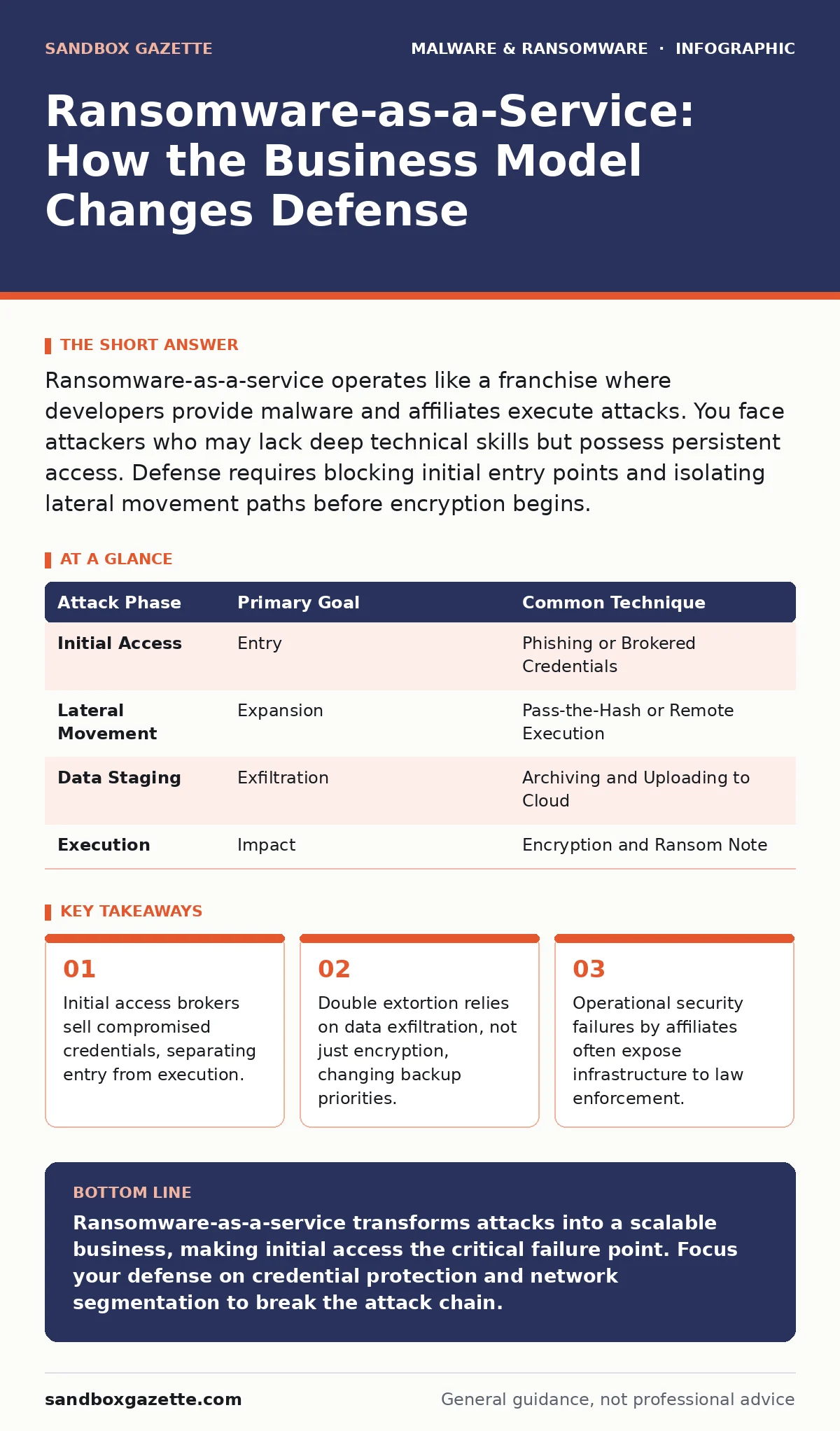
| Attack Phase | Primary Goal | Common Technique |
|---|---|---|
| Initial Access | Entry | Phishing or Brokered Credentials |
| Lateral Movement | Expansion | Pass-the-Hash or Remote Execution |
| Data Staging | Exfiltration | Archiving and Uploading to Cloud |
| Execution | Impact | Encryption and Ransom Note |
What makes the service model resilient to takedowns?
The modular nature means that taking down one component rarely stops the entire operation. If developers lose their infrastructure, they can rebuild quickly using new domains and servers. Affiliates may switch to competing ransomware groups if their current provider is disrupted. This resilience stems from the fact that the malware code and the attack infrastructure are decoupled. You must defend against the behavior, not just the specific file signature.
How can you disrupt the affiliate-developer relationship?
Disruption requires increasing the cost and difficulty of the attack lifecycle. Implement strict least-privilege access to limit the value of compromised credentials. Use network segmentation to prevent lateral movement from a single infected host. Regularly audit third-party access, as brokers often target vendors with weaker security. By making the network hard to move through, you reduce the appeal of your environment to affiliates seeking quick returns.
What are the limitations of this business model?
The reliance on untrusted affiliates creates inherent security risks for the developers. Affiliates may leak code, share tactics, or cooperate with law enforcement to reduce their sentences. This internal threat vector has led to several high-profile disruptions of ransomware groups. Developers must constantly verify the loyalty and operational security of their partners, which adds overhead and potential points of failure.
How does this affect incident response priorities?
Response must prioritize containment over immediate remediation. Isolate affected segments to stop lateral movement and data exfiltration before focusing on decryption. Preserve forensic evidence to identify the entry point and the scope of data theft. Engage legal and communications teams early, as the decision to pay involves regulatory and reputational considerations beyond technical recovery. A structured approach prevents panic-driven decisions that may worsen the outcome.
Key takeaways
- Initial access brokers sell compromised credentials, separating entry from execution.
- Double extortion relies on data exfiltration, not just encryption, changing backup priorities.
- Operational security failures by affiliates often expose infrastructure to law enforcement.
Ransomware-as-a-service transforms attacks into a scalable business, making initial access the critical failure point. Focus your defense on credential protection and network segmentation to break the attack chain.
Frequently asked questions
Can I trace the attackers back to their real identities?
Tracing is difficult due to encryption and anonymization services, but analyzing infrastructure and payment trails can sometimes reveal patterns useful for attribution.
Is paying the ransom ever recommended?
Paying does not guarantee data recovery or silence, and it may encourage further attacks. Most frameworks advise against payment due to legal and ethical risks.
How do I protect against initial access brokers?
Enforce multi-factor authentication, monitor for anomalous login locations, and regularly review access rights for external partners and employees.
What is the difference between this and traditional malware?
Traditional malware is often created by a single actor, while this model involves a supply chain with specialized roles for development, access, and negotiation.
How this guide was produced: written by the Sandbox Gazette editorial team with AI assistance, checked against the public references listed below, and reviewed when the facts change. See our editorial policy or report an error.