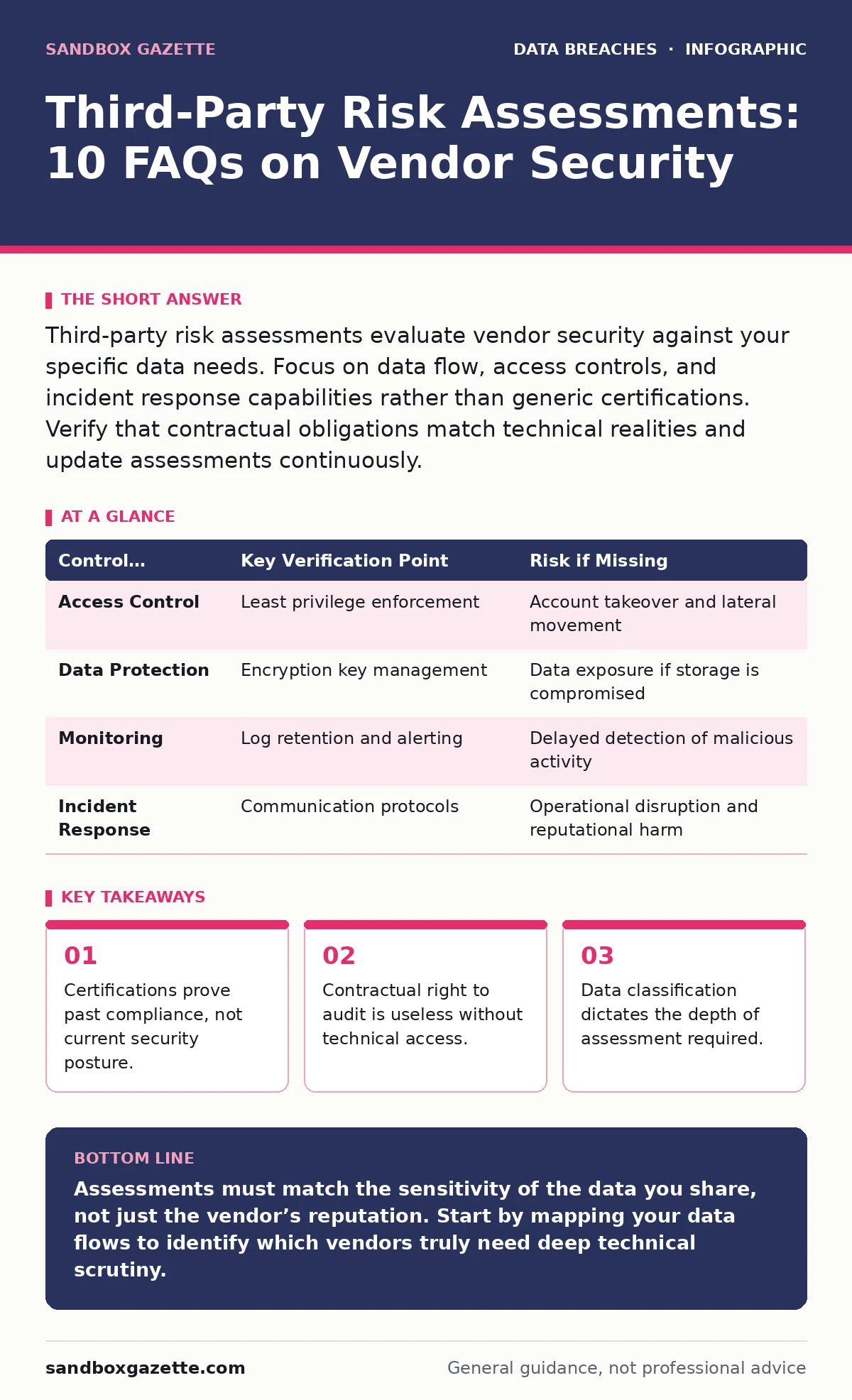
Third-party risk assessments evaluate vendor security against your specific data needs. Focus on data flow, access controls, and incident response capabilities rather than generic certifications. Verify that contractual obligations match technical realities and update assessments continuously.
What exactly is a third-party risk assessment?
It is a structured evaluation of a vendor’s security controls relative to the specific data and systems they access. You are not judging their entire organization, but only the perimeter around your shared assets. This distinction prevents scope creep and focuses resources on actual exposure.
How deep should the assessment go?
Depth correlates directly with data sensitivity and access level. A vendor hosting public marketing content requires minimal scrutiny, while one processing payment data demands rigorous technical validation. Align your effort with the potential impact of a breach within that specific vendor relationship.
Are security certifications enough to skip the assessment?
No, certifications like SOC 2 or ISO 27001 are snapshots in time that prove historical compliance. They do not guarantee current security posture or effective implementation of controls today. A certificate confirms a process exists; it does not verify that the process works under attack.
What is the difference between a questionnaire and an audit?
A questionnaire collects self-reported data on policies and procedures. An audit involves independent verification of those claims through evidence review or technical testing. Questionnaires are prone to bias and error; audits provide objective proof of control effectiveness.
Who should perform the assessment?
Internal security teams handle low-risk vendors using standardized templates. High-risk vendors require specialized expertise, often from dedicated third-party risk managers or external consultants. Match the assessor’s skill level to the complexity of the vendor’s environment.
See also: Backup vs Archive: The Critical Difference for Data Resilience · SOC 2 vs ISO 27001: Which Standard Fits Your Security Posture
How do you assess a vendor that won’t share details?
Refuse access to sensitive data until they provide sufficient assurance of their controls. You cannot manage risk you cannot measure, and opacity is a risk indicator in itself. Negotiate a limited scope disclosure or use a trusted broker to validate their claims.
What technical controls matter most?
Focus on identity and access management, encryption at rest and in transit, and incident response capabilities. These controls directly protect your data from unauthorized access and exfiltration. Verify that multi-factor authentication is enforced for all administrative access points.
| Control Category | Key Verification Point | Risk if Missing |
|---|---|---|
| Access Control | Least privilege enforcement | Account takeover and lateral movement |
| Data Protection | Encryption key management | Data exposure if storage is compromised |
| Monitoring | Log retention and alerting | Delayed detection of malicious activity |
| Incident Response | Communication protocols | Operational disruption and reputational harm |
How often should you reassess?
Assess annually for high-risk vendors and upon significant changes in their service or your data usage. Continuous monitoring tools can provide real-time alerts for critical issues between formal reviews. Static annual reviews miss dynamic threats and configuration drift.
What if the vendor fails the assessment?
Define clear remediation paths and timelines before signing any agreement. You may require specific technical fixes, additional controls, or architectural changes to mitigate identified gaps. If they cannot meet your security requirements, you must find an alternative vendor.
How do you handle sub-supplier risk?
Require vendors to disclose their critical sub-suppliers and extend your security requirements to them. Your vendor is responsible for the entire chain, including those who process your data on their behalf. Verify that they actively monitor their own supply chain for security incidents.
What contractual clauses protect you?
Include rights to audit, clear data ownership terms, and specific breach notification timelines. Define liability limits and indemnification for security failures caused by their negligence. Ensure the contract allows you to terminate the relationship if security standards drop.
How do you monitor ongoing compliance?
Use automated tools to scan for public vulnerabilities and breach reports involving your vendors. Request regular control effectiveness reports and validate them against your initial assessment. Continuous visibility prevents surprises and ensures consistent security standards.
What is the biggest hidden cost of assessments?
The opportunity cost of delayed procurement and vendor frustration. Overly burdensome assessments can push vendors to competitors with lighter due diligence processes. Balance security rigor with business agility by tiering your assessment effort based on actual risk.
Key takeaways
- Certifications prove past compliance, not current security posture.
- Contractual right to audit is useless without technical access.
- Data classification dictates the depth of assessment required.
Assessments must match the sensitivity of the data you share, not just the vendor’s reputation. Start by mapping your data flows to identify which vendors truly need deep technical scrutiny.
Frequently asked questions
Can I use a third-party risk platform to automate assessments?
Yes, platforms can streamline data collection and scoring, but they cannot replace human judgment for high-risk evaluations. They are tools for efficiency, not substitutes for critical analysis.
How do I assess a startup with limited security resources?
Focus on fundamental controls like access management and data encryption rather than mature governance frameworks. Look for willingness to improve and clear incident response
How this guide was produced: written by the Sandbox Gazette editorial team with AI assistance, checked against the public references listed below, and reviewed when the facts change. See our editorial policy or report an error.