
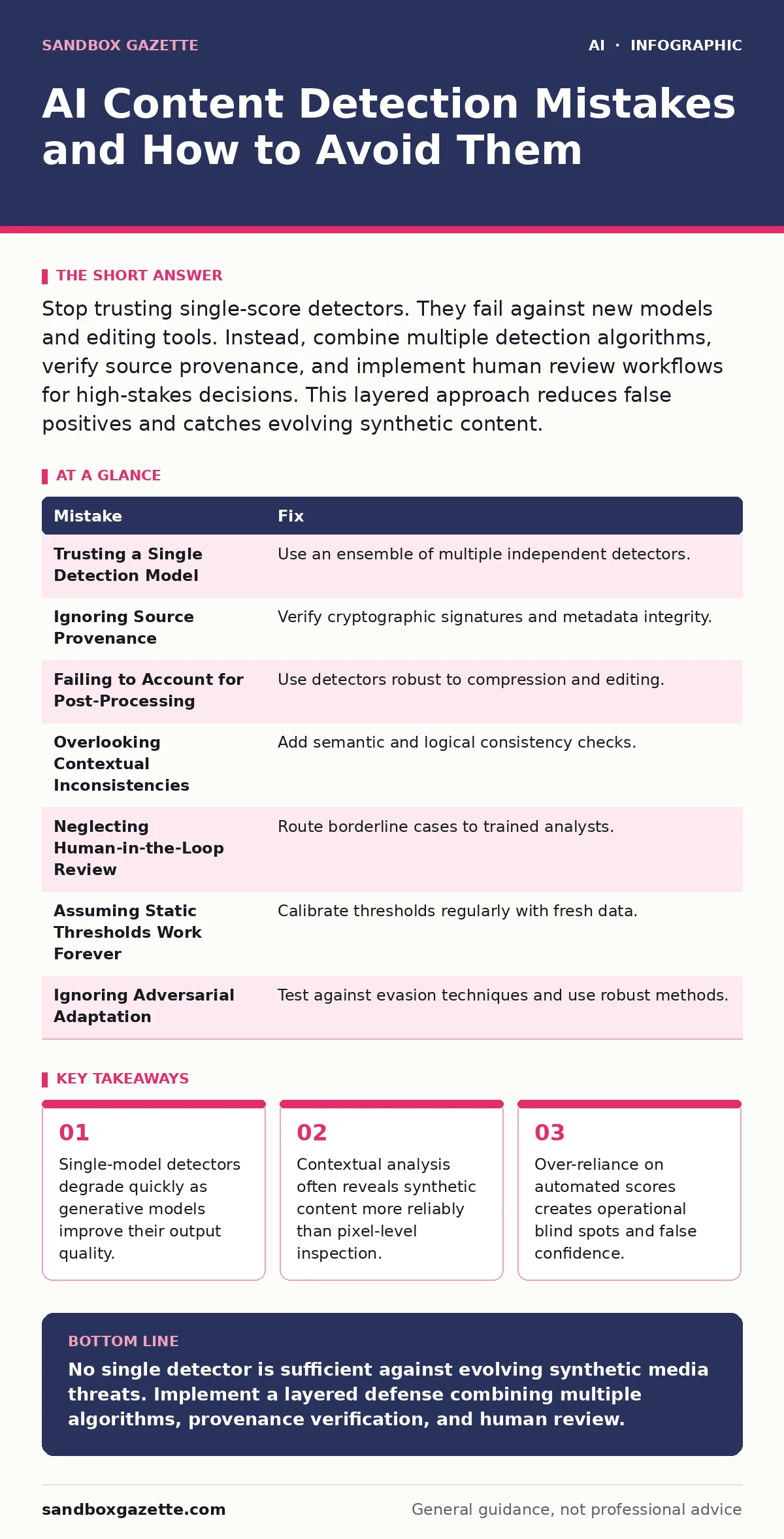
Stop trusting single-score detectors. They fail against new models and editing tools. Instead, combine multiple detection algorithms, verify source provenance, and implement human review workflows for high-stakes decisions. This layered approach reduces false positives and catches evolving synthetic content.
Mistake 1: Trusting a Single Detection Model
Using one algorithm to determine if content is human-made or synthetic creates a fragile security posture. Generative models evolve rapidly, often bypassing specific detection signatures within weeks of release. A single model relies on static patterns that become obsolete as training data and architectures change.
Why it hurts:
When a new generation of models emerges, the detector’s accuracy drops precipitously. You face a binary choice: accept high false positives that flag legitimate content, or miss genuine synthetic media. This instability breaks automated workflows and erodes trust in your verification process.
The fix:
Implement an ensemble approach that queries multiple independent detection models simultaneously. Each model uses different features, such as frequency artifacts or semantic inconsistencies. Require consensus or a high weighted score before flagging content. This diversity ensures that if one model fails, others may still catch the anomaly.
Mistake 2: Ignoring Source Provenance and Metadata
Many teams focus exclusively on the visual or textual content while ignoring the digital trail left by its creation. Modern generative tools can embed cryptographic signatures or metadata tags that indicate synthetic origin. Stripping this data during ingestion removes a primary layer of verification.
Why it hurts:
Without provenance data, you are analyzing a vacuum. An attacker can easily strip metadata from synthetic images or text before submission. You lose the ability to trace the content back to its creator or generation tool, making attribution and accountability impossible.
The fix:
Integrate provenance standards like Content Credentials into your intake pipeline. Verify that files retain their cryptographic chain of custody. If metadata is missing or tampered with, flag the content for manual review regardless of the detection score. Treat missing provenance as a risk indicator, not a neutral state.
Mistake 3: Failing to Account for Post-Processing
Generative content rarely enters your systems in its raw form. Users apply compression, filters, cropping, and color adjustments that alter the statistical fingerprints detectors rely on. Many detection tools are trained on pristine outputs from specific models, not on real-world edited media.
Why it hurts:
Post-processing destroys the subtle artifacts that detectors use to identify synthetic media. A simple JPEG compression can eliminate the frequency-domain anomalies that signal AI generation. Your detector may report "human" for heavily edited synthetic content, creating a false sense of security.
The fix:
Train or select detectors that are robust to common transformations. Use detection models specifically tested against compression and filtering. Combine technical detection with contextual analysis, such as checking for inconsistent lighting or physics violations that survive editing.
Mistake 4: Overlooking Contextual Inconsistencies
Technical detectors often miss semantic errors that a human reader would catch immediately. Synthetic text may contain plausible-sounding facts that are internally contradictory or historically impossible. Relying solely on statistical probability misses these logical flaws.
Why it hurts:
Contextual errors are harder for generative models to eliminate than pixel artifacts. They require deep understanding rather than pattern matching. If you ignore context, you allow synthetic content that passes technical checks to propagate misinformation or fraud.
The fix:
Integrate semantic analysis tools that check for logical consistency and factual grounding. Cross-reference claims against trusted knowledge bases. For images, analyze scene coherence, such as shadow directions and object interactions. Combine these checks with your technical detection scores for a holistic view.
Mistake 5: Neglecting Human-in-the-Loop Review
Automated systems provide speed but lack judgment. They cannot understand nuance, satire, or artistic intent. Treating detection scores as definitive truths leads to automated censorship or the passage of malicious content. Humans remain superior at interpreting ambiguous cases.
Why it hurts:
False positives disrupt user experience and business operations. False negatives allow harmful content to slip through. Without human oversight, you cannot adapt to novel attack vectors or unusual creative uses of AI. Your system becomes rigid and easily gamed.
The fix:
Define clear thresholds for automated action versus manual review. Route borderline cases to trained analysts. Provide reviewers with detailed explanations from the detection models, not just a pass/fail score. Continuously train your human team on the latest synthetic media trends and detection limitations.
See also: What Does AI Transparency Refer To: Mechanisms, Gaps and Controls · Emergency Stop for AI Systems: 8 Critical Questions Answered
Mistake 6: Assuming Static Thresholds Work Forever
Detection scores are probabilistic, not absolute. Setting a fixed cutoff for "synthetic" content ignores the changing nature of both the threat and the detector’s performance.
Why it hurts:
Static thresholds lead to increasing error rates over time. As synthetic content becomes more realistic, scores for human content may rise, or scores for synthetic content may fall. You either block too much legitimate content or let too much synthetic content through.
The fix:
Regularly calibrate your thresholds based on recent ground truth data. Monitor the distribution of scores for both human and synthetic samples. Adjust cutoffs dynamically to maintain your desired balance of precision and recall. Document these changes to ensure auditability.
Mistake 7: Ignoring Adversarial Adaptation
Attackers actively test detection systems to find weaknesses. They can add noise, perturb pixels, or tweak text to evade detection without altering the perceived content. Assuming your detector is a black box that cannot be reverse-engineered is a critical error.
Why it hurts:
Adversarial examples exploit the specific decision boundaries of your model. A small, imperceptible change can flip the classification from "synthetic" to "human." This renders your detection layer ineffective against determined adversaries.
The fix:
Adopt an adversarial mindset in your security design. Test your detectors against known evasion techniques. Use robust detection methods that are less sensitive to small perturbations. Consider the insights from prompt injection attacks to understand how input manipulation can bypass safety layers. Integrate LLM guardrails to restrict the capabilities of the models you use for detection.
| Mistake | Fix |
|---|---|
| Trusting a Single Detection Model | Use an ensemble of multiple independent detectors. |
| Ignoring Source Provenance | Verify cryptographic signatures and metadata integrity. |
| Failing to Account for Post-Processing | Use detectors robust to compression and editing. |
| Overlooking Contextual Inconsistencies | Add semantic and logical consistency checks. |
| Neglecting Human-in-the-Loop Review | Route borderline cases to trained analysts. |
| Assuming Static Thresholds Work Forever | Calibrate thresholds regularly with fresh data. |
| Ignoring Adversarial Adaptation | Test against evasion techniques and use robust methods. |
Key takeaways
- Single-model detectors degrade quickly as generative models improve their output quality.
- Contextual analysis often reveals synthetic content more reliably than pixel-level inspection.
- Over-reliance on automated scores creates operational blind spots and false confidence.
No single detector is sufficient against evolving synthetic media threats. Implement a layered defense combining multiple algorithms, provenance verification, and human review.
Frequently asked questions
How often should I update my detection models?
Update models regularly, at least quarterly, to account for new generative capabilities and shifting threat patterns.
Can I rely on open-source detection tools?
Open-source tools are valuable but require careful validation and integration into a broader security strategy.
What is the biggest risk of false positives?
False positives erode user trust and disrupt legitimate business operations, potentially causing more harm than the synthetic content itself.
How do I handle detection of text versus images?
Use specialized detectors for each modality, as the artifacts and detection methods differ significantly between text and visual media.
How this guide was produced: written by the Sandbox Gazette editorial team with AI assistance, checked against the public references listed below, and reviewed when the facts change. See our editorial policy or report an error.