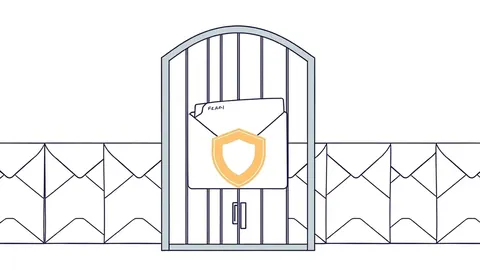
Invoice fraud is a deception scheme where attackers manipulate payment requests to divert funds. They alter bank details or create fake vendors, exploiting the gap between receiving a request and verifying its authenticity. You reduce risk by separating payment initiation from approval and verifying changes through out-of-band channels.
The Broken Envelope Analogy
Imagine receiving a letter from your landlord requesting a rent increase. The envelope looks correct, the signature matches, and the tone is familiar. You write the check and mail it. Only later do you realize the letter arrived via a different postal route, and the bank account number changed by a single digit. The envelope was authentic in appearance, but the content was intercepted and altered. Invoice fraud operates on this same principle. It exploits the assumption that a digital message’s appearance guarantees its integrity.
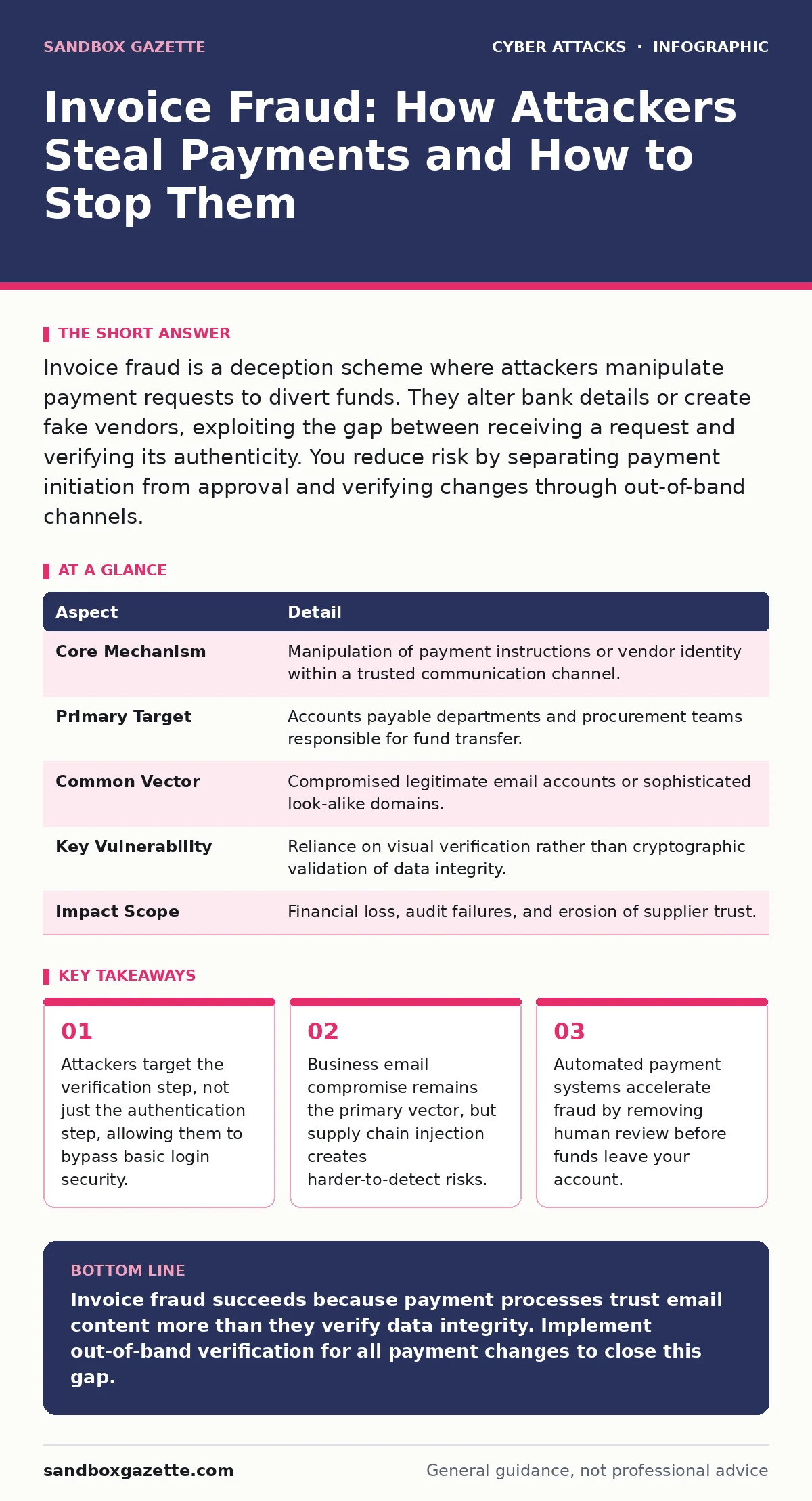
| Aspect | Detail |
|---|---|
| Core Mechanism | Manipulation of payment instructions or vendor identity within a trusted communication channel. |
| Primary Target | Accounts payable departments and procurement teams responsible for fund transfer. |
| Common Vector | Compromised legitimate email accounts or sophisticated look-alike domains. |
| Key Vulnerability | Reliance on visual verification rather than cryptographic validation of data integrity. |
| Impact Scope | Financial loss, audit failures, and erosion of supplier trust. |
How Invoice Fraud Happens
Attackers do not always need to break into your network. They often work outside your perimeter, manipulating the communication layer between you and your vendors. The process typically begins with reconnaissance. Attackers monitor public procurement notices, press releases, or social media to identify upcoming contracts or new suppliers. They then position themselves to intercept or mimic the payment request.
The most common method involves compromising a legitimate vendor’s email account. Once inside, the attacker waits for an invoice to be generated. They intercept the email, change the bank account details to one they control, and forward it to you. Because the email comes from the actual vendor’s address, standard spam filters and user intuition fail to raise alarms. The attacker relies on the speed of payment cycles. If you pay within 24 hours, the vendor may not notice the missing funds until their own reconciliation process catches the discrepancy.
Common Forms of Deception
Invoice fraud manifests in several distinct patterns, each exploiting different weaknesses in your workflow. Understanding these forms helps you recognize the specific tactic in use.
- Supplier Email Compromise: The attacker hijacks a real vendor’s mailbox. The invoice is genuine, but the payment instructions are altered. This form is difficult to detect because the sender address is legitimate.
- Vendor Impersonation: The attacker creates a new email address that looks similar to the vendor’s. They may use brand impersonation techniques to mimic the logo and layout of the invoice. This relies on your team failing to notice the slight difference in the domain name.
- Fake Vendor Injection: The attacker creates a completely fictional company. They send unsolicited invoices or quote requests. If your procurement process lacks strict vendor onboarding checks, you may pay for services never rendered. This often overlaps with typosquatting, where the attacker registers a domain name that is a slight misspelling of a well-known supplier.
- Invoice Splitting: The attacker breaks a large payment into smaller amounts to bypass approval thresholds. This exploits internal controls that require dual authorization only for transactions above a certain limit.
Who It Affects and Why
Every organization that pays for goods or services is a potential target. Small businesses are attractive because they often lack dedicated finance teams to verify discrepancies. Large enterprises are attractive because the volume of transactions creates noise, making it easier for a single fraudulent invoice to slip through.
The attack affects more than just your balance sheet. It disrupts supplier relationships. When a vendor discovers you paid an attacker instead of them, they may delay future shipments or demand immediate reimbursement. This damages your credit standing and operational continuity. Additionally, if the fraud involves a third-party service provider, the breach may expose sensitive contract terms or pricing data to competitors.
What People Usually Get Wrong
Most organizations focus heavily on preventing unauthorized access to their own systems. They install firewalls, enforce multi-factor authentication, and train staff to recognize phishing links. This approach misses the core mechanic of invoice fraud. The attacker often does not need to enter your network. They only need to manipulate the data before it enters your verification process.
A common misconception is that checking the email address is sufficient. Attackers know this. They compromise the actual email account of your vendor. The email header shows the correct sender. The digital signature, if present, may be valid for the original message, but the attachment has been swapped. Another error is relying solely on visual inspection of PDFs. Modern editing tools allow attackers to alter text in PDFs without leaving obvious artifacts. The file hash changes, but the visual layout remains identical.
See also: How to Avoid Email Spoofing: Stop Forged Messages at the Gate · How to Prevent Typosquatting: Stop Impersonation at the DNS Layer
How to Reduce the Risk
Reducing risk requires shifting from trust-based verification to proof-based verification. You must assume that any digital communication can be altered or spoofed.
- Out-of-Band Verification: Never process a payment change based solely on email. If an invoice requests a new bank account, call the vendor using a number from your existing records, not the one in the email. This breaks the attacker’s chain of control.
- Dual Control for Changes: Implement a policy where any change to vendor payment details requires approval from two different people. One person initiates the change, and another, who did not receive the original request, approves it. This prevents a single compromised account from triggering a payout.
- Cryptographic Signing: Encourage vendors to sign invoices using digital certificates. This ensures that the document has not been altered since it was created. If the signature is invalid, the invoice is rejected. This adds a layer of technical proof that visual inspection cannot provide.
- Vendor Onboarding Rigor: Verify new vendors through independent channels. Do not accept bank details from a cold email. Require a signed contract and a direct phone call to confirm the entity’s legitimacy. This reduces the surface area for business email compromise attacks that rely on fake entities.
- Review Payment Logs: Regularly audit paid invoices against received goods or services. Discrepancies often appear only after the fact. A structured cyber incident response team should include financial fraud in its scope, ensuring that detection triggers an immediate freeze on further payments.
The Hidden Cost of Speed
Organizations often prioritize payment speed to maintain good relationships with suppliers. This speed creates a window of vulnerability. The faster you pay, the less time you have to verify. Attackers exploit this urgency by sending invoices near the end of the month or with tight deadlines.
Slowing down the process slightly can prevent significant losses. Implementing a mandatory waiting period for new vendor payments or changed bank details adds friction. This friction is a feature, not a bug. It forces a pause for verification. The trade-off is minor administrative delay versus the major cost of fraud recovery.
Integrating Defense into Daily Operations
Defense against invoice fraud is not a one-time configuration. It is a continuous process of verification and adjustment. You must treat payment instructions as untrusted data until proven otherwise. This mindset shift requires training that goes beyond generic security awareness. Staff must understand the mechanics of account takeover and the limitations of email as a verification tool.
Regularly update your vendor contact lists. Remove old email addresses and verify current ones. This reduces the chance that an attacker can use an old, less-monitored address to send fraudulent requests. Additionally, monitor for MFA fatigue attacks targeting your finance team. Attackers may bombard users with approval requests to force a mistake. Training staff to ignore pressure and follow strict verification protocols is the only defense against this social engineering tactic.
Key takeaways
- Attackers target the verification step, not just the authentication step, allowing them to bypass basic login security.
- Business email compromise remains the primary vector, but supply chain injection creates harder-to-detect risks.
- Automated payment systems accelerate fraud by removing human review before funds leave your account.
Invoice fraud succeeds because payment processes trust email content more than they verify data integrity. Implement out-of-band verification for all payment changes to close this gap.
Frequently asked questions
Can I trust an invoice if it has a digital signature?
Only if you verify the signature against the vendor’s known certificate. Attackers can create self-signed certificates that look valid but are not trusted by your organization.
Does two-factor authentication stop invoice fraud?
It stops attackers from easily accessing your own accounts, but it does not prevent them from compromising your vendor’s account or spoofing their identity.
How do I verify a vendor without calling them?
Use a secure portal or a verified messaging platform where the vendor’s identity is cryptographically established. Avoid using email for sensitive financial changes.
What is the first step if I suspect fraud?
Immediately freeze the payment and contact your financial institution to recall the funds. Simultaneously, contact the vendor through a trusted channel to confirm the discrepancy.
How this guide was produced: written by the Sandbox Gazette editorial team with AI assistance, checked against the public references listed below, and reviewed when the facts change. See our editorial policy or report an error.