
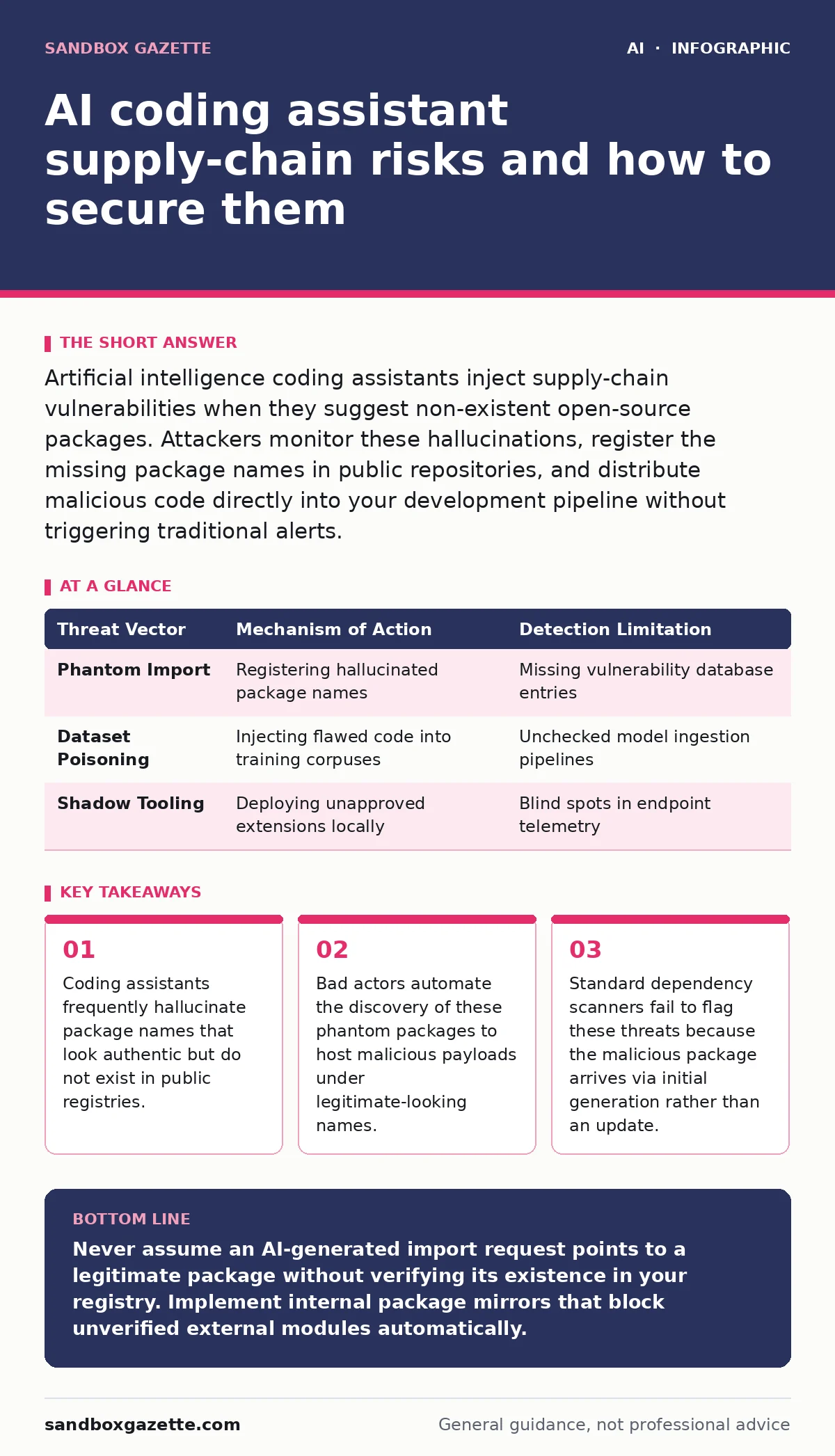
Artificial intelligence coding assistants inject supply-chain vulnerabilities when they suggest non-existent open-source packages. Attackers monitor these hallucinations, register the missing package names in public repositories, and distribute malicious code directly into your development pipeline without triggering traditional alerts.
How do AI coding assistants create supply-chain vulnerabilities?
Artificial intelligence coding assistants create supply-chain vulnerabilities by generating code that relies on non-existent third-party libraries. Developers often accept these suggestions without verifying whether the suggested package actually exists in public repositories. Attackers exploit this behavior by mapping common programming patterns and waiting for models to invent specific import statements.
Automated generation tools prioritize linguistic plausibility over factual existence when constructing software solutions. 3 checks on every generated import statement remain necessary because syntax highlighting cannot distinguish between real and fabricated modules. Software engineers routinely trust autocomplete suggestions during rapid prototyping sessions.
What makes hallucinated package names dangerous to development pipelines?
Hallucinated package names are dangerous to development pipelines because language models fabricate plausible identifiers with high confidence. Language models prioritize statistical likelihood over factual accuracy when generating syntax for complex frameworks. 3 checks on generated imports are necessary because a convincing module name masks the complete absence of upstream vetting.
Silent failures occur when development environments attempt to fetch non-existent packages from external registries. 2 safeguards help mitigate this behavior by forcing local package managers to fail closed when an identifier lacks verification. Unchecked dependency resolution exposes local workstations to immediate code execution upon installation.
Why do standard dependency scanners miss AI-generated threats?
Standard dependency scanners miss AI-generated threats because traditional tools rely on known vulnerability databases rather than novel creation checks. Software composition analysis tools evaluate existing project manifests against recorded advisories rather than inspecting the origin of newly introduced dependencies. 2 checks on your build process reveal that entirely new packages bypass historical signature matching entirely.
Signature databases require prior documentation of malicious behavior before generating alerts for security teams. 4 limitations plague signature matching when confronting dynamically generated supply-chain vectors. Automated generation creates unique attack surfaces that elude static analysis definitions.
| Threat Vector | Mechanism of Action | Detection Limitation |
|---|---|---|
| Phantom Import | Registering hallucinated package names | Missing vulnerability database entries |
| Dataset Poisoning | Injecting flawed code into training corpuses | Unchecked model ingestion pipelines |
| Shadow Tooling | Deploying unapproved extensions locally | Blind spots in endpoint telemetry |
How can attackers exploit repository squatting through model suggestions?
Attackers exploit repository squatting through model suggestions by registering names that neural networks frequently hallucinate. Criminal networks monitor public telemetry and query large language models systematically to discover recurring naming errors across popular programming languages. Once an attacker claims a phantom name, any developer running the installation command downloads the malicious payload automatically.
Typosquatting strategies evolve rapidly when combined with large language model telemetry feeds. 2 patterns dominate these campaigns: registering slight variations of standard libraries and claiming entirely fabricated module namespaces. Automated registration scripts ensure malicious packages appear instantly when models suggest them.
What role does shadow AI play in bypassing internal security controls?
Shadow AI plays a major role in bypassing internal security controls by introducing unmonitored tools directly onto corporate workstations. Employees frequently install browser extensions and desktop coding plugins without enterprise authorization or security review. 4 risks emerge when unsanctioned models ingest proprietary source code and suggest external dependencies without organizational oversight.
Unmonitored coding assistants operate outside central logging and vulnerability management systems. 3 blind spots hinder security visibility when developers rely on consumer-grade generation tools. Endpoint monitoring tools struggle to intercept telemetry streams generated by unauthorized browser plugins.
See also: Exposed AI Model Servers: Secure Your Endpoints and APIs
How do data poisoning attacks affect downstream code generation?
Data poisoning attacks affect downstream code generation by corrupting the training datasets used to build foundational programming models. Adversaries inject malicious code snippets into public repositories, knowing that web scrapers will ingest the flawed patterns during subsequent model retraining cycles. 5 steps separate an altered training sample from a deployed assistant recommending insecure cryptographic functions.
Corrupted training data alters the statistical weights governing code completion outputs. 2 consequences arise when models internalize flawed syntax: widespread propagation of insecure coding patterns and subtle introduction of backdoors. Cleaning multi-terabyte training corpora remains an unsolved challenge for foundational model builders.
What mechanisms help detect unauthorized packages in local environments?
Mechanisms that help detect unauthorized packages in local environments include private artifact registries and strict mirror configurations. Local proxy servers intercept all outbound package requests and block installations that lack pre-approval. 2 checks at the network boundary prevent developers from fetching unverified dependencies directly from public sources.
Behavioral monitoring tools observe package installation commands for anomalous outbound network connections. 3 rules govern effective local artifact management: restricting public internet access during builds, maintaining cached dependency stores, and logging all installation attempts.
How does AI in security operations change code review workflows?
AI in security operations changes code review workflows by shifting the burden from manual syntax inspection to automated behavioral monitoring. Automated analysis engines evaluate pull requests for anomalous dependency additions alongside traditional logic flaws. 3 metrics track whether review systems catch novel supply-chain injections before code merges into main branches.
Review bottlenecks decrease when automated agents pre-screen pull requests for unauthorized imports. 2 advantages emerge from automated triage: faster feedback loops for developers and consistent enforcement of dependency policies. Automated review tools must integrate directly with internal artifact registries to verify package provenance.
What trade-offs exist between developer velocity and supply-chain safety?
Trade-offs between developer velocity and supply-chain safety involve balancing immediate feature delivery against rigorous dependency verification overhead. Strict approval gates slow down local prototyping while stopping unauthorized package downloads. 2 constraints govern this balance: security teams must automate verification to prevent developers from bypassing safety controls entirely.
Friction in the development workflow often encourages engineers to seek unauthorized bypass methods. 3 strategies reduce friction without sacrificing security posture: implementing automated registry lookups, providing pre-approved dependency templates, and streamlining exception requests. Balancing speed and safety requires continuous tuning of security gates.
Key takeaways
- Coding assistants frequently hallucinate package names that look authentic but do not exist in public registries.
- Bad actors automate the discovery of these phantom packages to host malicious payloads under legitimate-looking names.
- Standard dependency scanners fail to flag these threats because the malicious package arrives via initial generation rather than an update.
Never assume an AI-generated import request points to a legitimate package without verifying its existence in your registry. Implement internal package mirrors that block unverified external modules automatically.
Frequently asked questions
How can developers test if a suggested package is real before installing it?
Developers should query the public registry API directly or check internal mirrors before running any installation command.
Do offline coding assistants eliminate supply-chain risks entirely?
Offline models still suggest external dependencies, leaving open the risk of hallucinated package names.
Are paid enterprise coding assistants immune to package hallucinations?
Commercial models reduce hallucination rates through fine-tuning, but they cannot eliminate inventive naming errors.
How do package managers handle unknown dependencies during builds?
Package managers attempt to fetch missing identifiers from configured remote sources, executing arbitrary installation scripts if a match is found.
How this guide was produced: written by the Sandbox Gazette editorial team with AI assistance, checked against the public references listed below, and reviewed when the facts change. See our editorial policy or report an error.